

The idea of three men sharing one relationship turns up in private fantasies, in conversations between partners, and in the profiles people write on apps. The psychology of gay triad relationships is mostly about what the idea answers: a want for novelty, for belonging, for a relationship shaped to fit you, or for proof that you are wanted. Some of those wants a triad can meet. Others it can only make louder.
This article looks at why the pull is so common and what sits under it. It does not argue for triads or against them. Wanting something and being able to build it are separate questions, and most of the trouble comes from treating them as one.
Fantasy, curiosity or a real wish: what the pull toward three can mean
The same thought can mean three different things, and it helps to sort out which one you have.
A fantasy is an image that does its work in your head. It may be about being desired by two people at once, or about one particular man you cannot have. Plenty of men have fantasies they never want to act on, and the content of a fantasy does not tell you what you want in daily life. A fantasy that stays a fantasy is not a problem to solve.

Curiosity is closer to a question: what would it be like? It wants information. Curiosity can be satisfied by reading, by talking with people who live in triads, or by a conversation with your partner that goes nowhere further.
A real wish tends to be more practical. You find yourself thinking about the ordinary parts: who sleeps where on a Tuesday, who meets whose friends, how holidays work. The image has moved from the bedroom to the calendar. That shift from imagery to logistics is one of the clearer signs that something more than fantasy is involved.
A few questions can help you tell them apart:
- Is the person in your mind a specific man, or a blank figure who exists to complete the picture?
- Does thinking about it feel arousing, or does it feel like relief?
- If it could never happen, would you feel loss, or would the thought simply fade?
None of these gives a verdict. They give you a better description of what you are dealing with, which is the starting point for every other question in this article.
Novelty and desire: why a third person changes the charge
Familiarity and desire pull against each other in many long relationships. The person you know best, whose habits and moods you can predict, is also the person it can be hardest to see as a stranger worth wanting. A third man brings a new body, a new voice, and a different rhythm into the room, and attention that had gone slack sharpens again.
There is another effect that has little to do with the new person. Watching your partner be wanted, and wanting someone alongside him, lets you see him from outside the relationship. Many people find that rediscovering their partner through another person's attention is arousing in itself. The third man may matter less as an individual than as a way of seeing the first one differently.
Novelty does not last, though, and this is where fantasy and a workable arrangement part ways. A third partner becomes familiar too. After the first months, a triad has its own routines, its own arguments, and its own quiet evenings. If the draw was the charge of someone new, a triad will deliver it for a while and then become what every long-term relationship becomes: a daily life that needs care.
A useful question here is whether you want novelty or want a sustainable structure. Novelty can come from many sources, including changes inside an existing relationship. A triad is a commitment to three relationships at once: you with each of the other two, and the two of them with each other, plus the group as a whole. It is a lot to take on for the sake of a spark.

Escaping the default script: how gay men often build relationships without a map
Most of the relationship scripts people absorb growing up were written for a man and a woman: meet, date, become exclusive, move in, marry, and divide the roles along familiar lines. Many gay men notice early that this script does not fit, and that it was never offered to them in the first place. Without a ready template, they have to decide things that straight couples often inherit: who does what, how open the relationship is, what counts as faithful, what a partner owes you.
That freedom is real, and it can be tiring. Every question is open, and every answer has to be negotiated. A triad can look attractive in this light because it makes the choosing visible. You are building something on purpose, and nobody can say you drifted into it because it was expected.
There is also a quieter pull. A lot of gay men spent years following rules set by other people, whether family, religion, or the need to stay safe. An arrangement you design yourself can feel like ownership over your own life in a way that a conventional relationship may not. The old script treats the couple as the unit and assumes one person should meet nearly all of another's emotional and sexual needs. A triad says those needs can be spread across more than one person, and for some men that is a relief to hear.
The risk is replacing one script with another. If unconventional is the thing you want to be, then a triad can become an identity rather than a relationship, and the people in it get cast in parts. A good test is whether you would still want this structure if nobody ever found out about it. If the appeal depends on how it looks to others, it is a statement more than a relationship.
Monogamy is also a script some men choose freely and want for good reasons. Wanting a different structure does not make you more evolved than the man who wants exclusivity, and wanting exclusivity does not make you conventional. The aim is to choose, not to rebel.
Attachment and jealousy: what a triad stirs up in anxious and avoidant people
Attachment theory describes broad tendencies in how people behave in close relationships. Some people lean anxious: they watch for signs of distance, need reassurance, and feel threatened when attention goes elsewhere. Some lean avoidant: they value independence, feel crowded by too much closeness, and pull back when a partner needs more. Many people are mostly secure, and most people shift depending on who they are with and what they have been through. These are patterns, not diagnoses, and they can change with experience and work.
A triad puts pressure on each pattern in a different way.
For a man with an anxious tendency, the structure has a built-in difficulty. In any group of three, two people can be together while the third is not, and the odd man out is a real position, not a hypothetical one. If you are quick to read distance as rejection, you may feel that position often, even when nobody intends it. Jealousy in this case is not a sign you are bad at triads. It is the signal of a fear that needs to be named and talked about.
For a man with an avoidant tendency, a triad can seem appealing because intimacy is divided. Nobody can depend on you completely if there are three of you. That can be a healthy fit when the people involved know what is happening, and it can be a way to avoid depth without admitting it. The test is whether you are drawn to the structure, or drawn to the distance it makes easy. A third person can also unsettle an avoidant man when two partners seem closer to each other than he is comfortable with.

Jealousy deserves a plain description. It is information about something you fear, such as being replaced, being less desired, or being left out. Some people feel compersion, a pleasure in a partner's happiness with someone else, and some do not. You do not need compersion to have a good triad, but you do need a way to say "I feel jealous" and be heard without being treated as the problem. If you already find that conversation hard in a pair, it will be harder with three.
If you recognise these patterns in yourself, a therapist who has experience with non-monogamous relationships can help you work through them before anyone else is involved.
The appeal of being chosen twice, and the fear underneath it
One of the strongest draws of a triad is rarely mentioned: being wanted by two people means two sets of evidence that you are worth choosing. For men who grew up hearing, directly or indirectly, that who they desire made them unacceptable, being chosen can carry a lot of weight. Being chosen twice can feel like proof against an old doubt.
The fear underneath tends to take one of two forms. One is a fear of not being enough for a single person: that one partner will eventually get bored, want more, or find someone better. In that case, a triad can look like insurance, because if one person's attention drifts, another is there. The other form runs the opposite way: a fear that one person could never be enough for you, which can be a real difference in desire, or a sign that you are looking for something that no partner alone could provide.
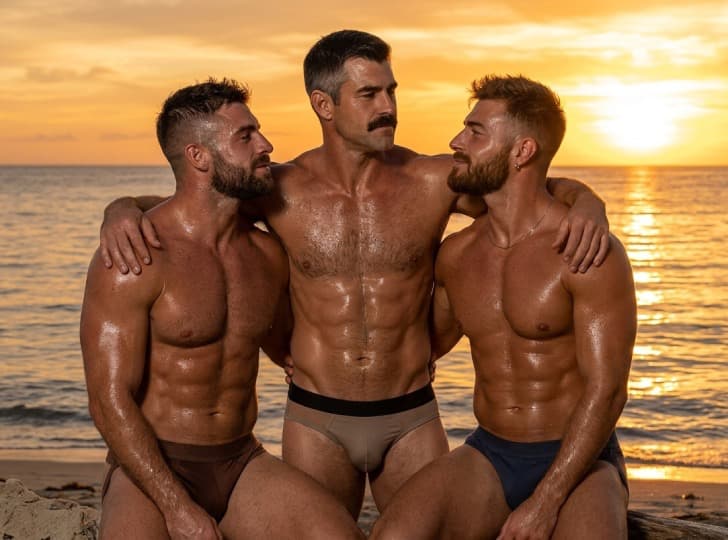
Celebrating Masculine Gay Love
Both fears are understandable, and a triad does not settle either. If the doubt lives inside you, being chosen by two men will not quiet it for long. The reassurance wears off, and it often gets replaced by comparison: am I the favourite, does he prefer the other man in bed, why did they laugh together over there? A structure with three people has three pairs to compare, and for a man who measures his worth by being picked, it can be harder to rest.
A question worth putting to yourself directly: if you felt completely secure in who you are, would you still want this? If the answer is yes, then the wish may be about what you want from life. If the answer is that the wish would mostly disappear, the wish is probably standing in for something else, and that something else deserves attention first.
When the draw is a fix for something else, such as a flat relationship or low self-worth
Sometimes the idea of a third man arrives because something in the relationship has gone wrong, and the third man looks like a solution.
Several situations tend to produce this:
- A flat relationship. Sex has become rare or routine, conversation has narrowed to logistics, and a new person promises to restore energy. A third partner can add energy, but he cannot repair what two people have stopped doing for each other.
- Mismatched desire. One partner wants more sex than the other, and a triad seems to solve the gap. It may, if everyone agrees to it honestly. It can also leave the lower-desire partner feeling pressured or replaced.
- Low self-worth. One or both partners hope another person's attention will make them feel attractive or valued. As described above, this seldom lasts.
- Avoiding a hard conversation. Instead of saying "I am unhappy" or "I want to end this," one partner proposes a change in structure and hopes it fixes everything.
- Keeping a partner. One man agrees to a triad because he fears that refusing will lose him the relationship. Consent given out of fear is not consent that will hold up.
Adding a person to a strained relationship adds load to a structure that is already struggling. The new man will notice the strain, and he has his own needs, which he did not sign up to have used as a remedy.
This does not mean a couple in a rough patch can never have a good triad. It means the reason matters and should be honest. A couple who says "we are secure, and we are curious" is in a different position from a couple who says "we are not sure we are okay, and maybe this helps." If you recognise the second description, the work to do first is between the two of you, and a couples therapist can help with that.
One more point: a couple seeking a third man for themselves, as though he were an addition to the household, sets up a poor situation for him. He is a person with a say in the arrangement. A triad where two men have already made every decision and a third is invited to fit in tends to end with the third man hurt, or gone.

Questions to ask yourself and your partner before this becomes more than a conversation
Talking about a triad is not a commitment, and it can be a useful conversation even if it ends in a decision against. These questions are meant to be answered honestly, and it is fine for them to take several sittings.
For yourself:
- What exactly am I drawn to: a particular man, an experience, being wanted, a different structure, or an escape from something?
- What would I want if I felt entirely secure?
- How do I behave when I feel jealous or left out? Do I withdraw, accuse, go quiet, or ask for what I need?
- Am I considering this because I want it, or because I think it will keep a partner or fix a problem?
- Could I live with the arrangement if it never turned out the way I picture it?
For you and your partner:
- What does each of us hope this would give us, and are those hopes the same?
- What would be off limits, and are those limits ours or only one person's?
- What happens if one of us wants to stop? Is stopping always allowed, with no punishment?
- How will we handle sexual health, including testing and what we do if boundaries change?
- How would we treat a third man: as an equal partner with a voice, or as an addition?
- How would we deal with time, money, living arrangements, and who knows about us?
- What would we do if two of us grew closer than the third?
Check how your partner reacts, not only what he says. If a question is met with defensiveness or a quick "it'll be fine," that is worth pausing on. A real conversation about three people should include some discomfort, because the subject is uncomfortable.
If the conversation stalls or turns into an argument, a therapist can help you both say what you mean. That is a sensible step, not a sign of failure.
The Queer Tarot: An Inclusive Deck and Guidebook
Tarot deck and guidebook set for LGBTQ+, created by queer and trans artist team Ash + Chess.
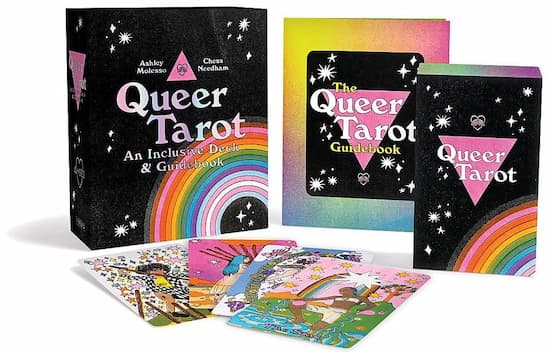
We earn a commission if you click this link and make a purchase at no additional cost to you.
Where to go next: the casual threesome to triad question
This article has been about why the idea pulls at you and what it asks of you, not about how things unfold once a third man is actually in the picture. If your question is the practical one, whether a casual encounter between three men can become something lasting, we cover that in an earlier piece: Can a Casual Gay Threesome Turn Into a Thriving Triad?
Whatever you decide, give the reasons a fair look first. A triad built from honest wants, with people who can tolerate each other's jealousy and uncertainty, is a different thing from one built to fill a gap. Knowing which one you are looking at is the most useful thing you can bring to the conversation.