

Physics has always been the science that asks big questions about how the universe works. From the motion of planets to the energy in a lightbulb, the insights from physics have shaped every part of modern life. Figures like Isaac Newton and Albert Einstein showed what can happen when someone combines curiosity with deep thinking. I find that learning about their main ideas not only makes me appreciate the world more, but also helps me see the invisible forces at play in daily experiences.
If you’ve ever wondered how objects move, why things fall, or how your GPS works, you’ve started down the same path that led to some of the greatest discoveries in history. Understanding key physics concepts shows just how far human reasoning can go. I’m going to share the 9 essential physics ideas that I think define genius and continue to spark new breakthroughs today.
1. Newton's Laws of Motion: Science Behind Everyday Movements
Isaac Newton’s three laws of motion are the foundation for classical mechanics. They describe how objects move and why they change direction or speed. My first physics lessons always came back to these laws.
- First Law (Law of Inertia): An object stays at rest or keeps moving unless a force changes that state. Think about sliding a puck on ice, it keeps going until friction or another object stops it.
- Second Law: The force on an object equals its mass times acceleration (F=ma). This means heavier objects need more force to move.
- Third Law: For every action, there’s an equal and opposite reaction. When I jump off a boat, I move one way and the boat moves the other.
Newton’s simple laws work well for skateboards, rocket launches, and most things I run into in daily life. They also let scientists predict how planets travel around the sun, building the groundwork for much bigger ideas.
You experience these constant exchanges of energy during every second of your physical existence on this planet.
A seatbelt stops your body from traveling through the windshield during a sudden stop in traffic. Inertia keeps you moving at the original speed of the car until a strap exerts a necessary counterforce.
Heavier grocery bags feel harder to lift because their mass resists any change in acceleration. Your muscles must generate more force to move the gallon of milk than the lightweight bag of bread.
Recoil from a garden hose pushes back against your hands when the water pressure is high. The stream moving out of the nozzle creates an equal push in the opposite direction against your grip.
Skateboards roll further on smooth tile than on thick carpet because of the reduction in friction. Surface texture serves as the external force that eventually brings the spinning wheels to a complete halt.
Spacecraft use small bursts of gas to change their trajectory in the silent void of the cosmos. Every action of the thrusters results in a reaction that moves the ship precisely where the pilot intends.
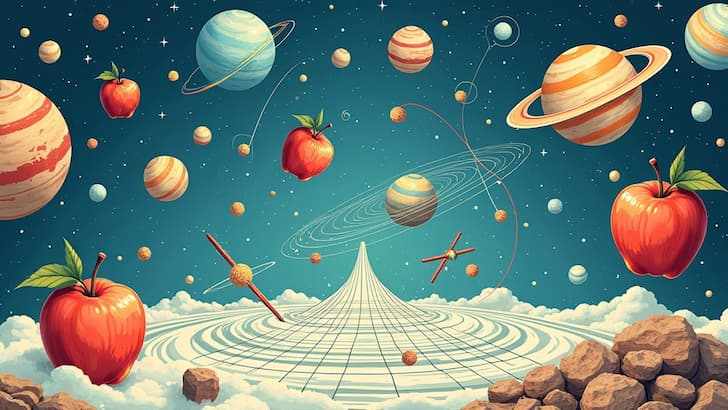
2. Universal Gravitation: Why Everything Falls. Here and in Space
Newton’s law of universal gravitation goes a step further than his laws of motion. It says every object pulls on every other object with a force that depends on their masses and the distance between them. If I drop a ball, gravity pulls it down. Gravity also keeps the moon in orbit around Earth and planets circling the sun.
The force gets weaker as things move farther apart, which is why astronauts float on the space station but the Earth still holds the moon close. Learning about gravity helped me understand that even the biggest cosmic movements follow simple, clear ideas.
- A scale measures the strength of the Earth's pull on your physical body. Weight is the result of gravity acting on your mass at a specific location on the planet.
- The tides in the ocean rise and fall because the moon pulls on the liquid water. Lunar gravity reaches across thousands of miles of space to shift the oceans on our planet.
- Apples fall straight down to the ground instead of floating away into the sky. Mass attracts mass in a predictable way that ensures objects return to the Earth when they are dropped.
- Mountains are harder to climb because you are moving directly against the pull of the planet. Every step upward requires energy to overcome the constant downward force of gravity acting on your frame.
- Satellites stay in orbit by moving fast enough to miss the Earth as they fall. Velocity prevents the craft from crashing while gravity keeps the vehicle from flying into the deep void.
3. Conservation of Energy: Energy Never Disappears
The principle of conservation of energy teaches that energy cannot be created or destroyed, only transferred or changed from one form to another. When I pedal a bike, energy from my muscles turns into movement. If I slam on the brakes, that energy turns into heat.
This idea means the energy I use isn’t just gone, it changes form. Photons from the sun power plants, which feed animals, which fuel people. Understanding energy conservation helped scientists design engines, build safer cars, and explain everything from chemical reactions to black holes. The topic has its own branch called thermodynamics, which jumps into energy flow, temperature, and heat.
Life continues because you are part of a massive chain of energy transfers that never truly ends.
Electric heaters turn the movement of electrons into thermal energy for your living room. Energy changes from an invisible flow into the warmth you feel on your skin during the winter.
Brakes on a car get hot because they turn kinetic energy into heat. Friction converts the motion of the wheels into thermal energy to bring the vehicle to a safe stop.
Food contains the chemical fuel your cells need to perform every task during the day. Digestion breaks down the molecules to release the energy stored within the structure of the meal.
Water behind a dam possesses potential energy that turns into electricity for the city. Gravity pulls the liquid down to spin turbines that generate power for thousands of homes.
Roller coasters use a motor to climb the first hill and gain potential energy. Gravity then takes over to convert that stored height into the speed of the descent on the tracks.
4. Electromagnetism: Connecting Electricity and Magnetism

James Clerk Maxwell brought together electricity, magnetism, and light into one elegant set of equations. Before learning about electromagnetism, I didn’t realize how much these forces shape our modern world. Flicking on a light switch, turning on a computer, or listening to the radio all use the rules of electromagnetism.
This field explains why magnets stick to your fridge, how electric motors run, and how radio waves travel through the air. Understanding this concept led to inventions like the telegraph, electric power grids, and WiFi. Many new technologies still build on Maxwell’s discoveries. In fact, our basic understanding of circuits in every device from smartphones to medical imaging equipment depends on these core ideas.
You are surrounded by a web of electromagnetic activity that shapes your daily experience of reality.
Magnets on your fridge stay in place because of the alignment of their internal atoms. Magnetic force holds the metal against the surface without the need for glue or tape.
Wireless chargers use induction to move energy from a pad to your phone battery. Coils of wire create a magnetic field that generates a current in the device through the air.
Microwaves heat your food by vibrating water molecules with electromagnetic waves. Energy travels through the air to reach the center of your meal in a matter of seconds.
Light bulbs turn electrical energy into visible radiation for your home or office. Filaments or gases glow when the flow of electrons reaches a certain intensity within the glass bulb.
Compass needles point north because they align with the magnetic field of the planet. Earth acts as a giant magnet that guides travelers across the surface of the globe for centuries.
5. Relativity: Speed Limits of the Universe
When Einstein published his theory of relativity, he changed the way scientists see time and space. The most famous part, special relativity, shows that the laws of physics are the same everywhere and that nothing can go faster than light in a vacuum.
Einstein’s work made me question everyday assumptions. For example, clocks tick slower at high speeds, and space can stretch and shrink depending on your position and speed. Without this idea, GPS systems would be off by miles every day, since satellites experience time slightly differently than clocks on the ground. Relativity revealed a flexible universe full of surprises, making it one of the boldest ideas in science. General relativity, Einstein’s extension of his theory, also gave us the notion of gravity not as a force but as a warping of space and time, changing the way we picture how massive objects interact.
You live in a flexible universe where the geometry of reality depends on the matter within the system.
GPS satellites must adjust their internal clocks to stay in sync with the ground. Time runs faster in space because the gravitational pull is weaker than on the surface of the planet.
Starlight bends as it passes near the sun during a solar eclipse in the sky. Massive bodies warp the space through which the light must travel to reach your eyes on Earth.
The orbit of Mercury follows a path that only relativity is able to explain. Gravitational warping near the sun changes the movement of the planet in a measurable and predictable way.
Nuclear power comes from the conversion of a tiny amount of mass into energy. Einstein's formula E=MC2 describes the immense power stored within a single atom of matter.
Muons created in the upper atmosphere reach the ground because time slows down for them. High speeds allow these short-lived particles to travel further than their lifespan should normally permit.
6. Quantum Mechanics: Weirdness at the Smallest Scale

The world gets strange when you look closely enough. Quantum mechanics describes how particles like electrons and photons move and interact. I remember first learning that particles can be in more than one state at once, or change when observed, and it felt like science fiction.
Quantum physics introduced concepts like superposition (being in several states at once) and entanglement (particles linked even when far apart). It helps explain lasers, semiconductors, MRI scans, and even the way the sun shines. This area is always growing. Today it’s at the heart of new ideas like quantum computers and encryption, with researchers regularly setting new records for quantum speed and security. This field reminds us that the universe is not as predictable or solid as it sometimes seems.
You are a large-scale being living on top of a foundation of quantum weirdness and hidden variables.
MRI machines use the quantum spin of atoms to create images of your body. Magnets and radio waves interact with the particles inside you to show internal structures to doctors.
Transistors in your phone act as tiny switches that control the flow of electrons. Quantum tunneling allows these components to function at a microscopic size in modern electronics.
LED lights produce bright colors by moving electrons between different energy levels. Semiconductors turn electrical power into light with very little heat waste compared to older bulbs.
Quantum encryption uses the rules of physics to protect your private data on the internet. Any attempt to eavesdrop on the signal changes the state of the particles in the message.
The sun produces energy through nuclear fusion that relies on quantum effects to function. Particles must tunnel through energy barriers to fuse and release the light of the stars to us.
7. Thermodynamics: The Laws of Heat, Work, and Disorder
Thermodynamics is all about how heat moves and changes things. I often think of boiling water or melting ice, but thermodynamics also shapes engines, batteries, and even living cells. There are four basic laws, but two of them show up everywhere.
- First Law (Energy Conservation): The total energy in an isolated system stays the same.
- Second Law: In any process, the disorder (entropy) of a system tends to increase. This explains why heat flows from hot coffee to a cold mug and why some processes can’t be reversed.
This field reminds me that while energy stays constant, the quality of energy changes over time. It’s why I have to recharge my devices and why perpetual motion machines don’t actually work. Thermodynamics even helps us understand climate change and energy efficiency, connecting physics to global challenges.
You are a biological engine that requires a constant intake of fuel to maintain your internal order and life.
Ice melts in a warm room because heat always seeks a path to cold areas. Thermal energy transfers from the air to the frozen water until they reach a thermal match.
Car engines require a cooling system to remove the excess heat of combustion. Only a small fraction of the fuel becomes motion while the rest becomes thermal waste in the air.
Sweating cools your body down through the process of evaporation on your skin. Heat leaves your skin to supply the energy needed to turn liquid into a gas during the day.
Batteries lose their charge over time even if you do not use the device at all. Entropy slowly breaks down the chemical order stored inside the power cell until it is gone.
Cooking a meal turns raw ingredients into a more disordered but delicious state. Heat changes the molecular structure of the food in an irreversible way that you can taste.
8. WaveParticle Duality: Light and Matter’s Double Life
Another mindbending idea from quantum physics is waveParticle duality. Depending how you look, light can act like a wave (spreading out, interfering) or like a particle (carrying specific amounts of energy). The same is true for tiny particles like electrons. When I first learned that matter isn’t just little balls, but can behave like waves, it gave me a much deeper appreciation for simple experiments like shining light through a pair of slits.
This concept is the reason lasers work, why CDs and DVDs can store information, and why scientists keep finding new uses for light and materials at the atomic scale. WaveParticle duality invites us to look beyond appearances, showing that reality has layers we’re still learning to peel back.
You perceive the universe through a lens that often hides this fundamental complexity of nature.
Solar panels turn the particle nature of light into electrical power for your home. Photons hit the surface and push electrons into a circuit to generate clean electricity.
Holograms use the wave interference of laser light to create three-dimensional images. Light waves overlap in a way that mimics the depth of a real object on a flat surface.
Electron microscopes give a much higher resolution than standard optical tools. Scientists use the tiny wavelengths of electrons to see individual atoms and molecules for the first time.
Lasers produce a coherent beam where all the light waves are in perfect sync. Alignment of these waves allows the light to stay focused over long distances for various tasks.
The photoelectric effect in a digital camera captures images by counting photons. Sensors convert the light particles into the digital data of a photograph on your screen.
9. The Standard Model: The Building Blocks of Everything
The Standard Model of particle physics is the “recipe” for all the fundamental stuff in the universe. It shows how protons, neutrons, electrons, and even smaller particles like quarks and neutrinos fit together and interact.
Scientists built this model by smashing particles together in accelerators and tracking down new members of the particle family over time. I’m always amazed at how precisely the Standard Model fits what we observe. It predicted new particles like the Higgs boson, which was actually found at CERN’s Large Hadron Collider in 2012. While the model isn’t perfect (it doesn’t yet explain gravity or dark matter), it is the best explanation I’ve seen for how the smallest pieces of the universe connect. The ongoing search for unifying principles that can bring the Standard Model and gravity together is one of physics’ biggest adventures.
The search for a theory of everything continues as researchers push the limits of what you know.
Protons and neutrons are made of smaller particles called quarks. These tiny bits are held together by the strongest force in the known universe inside the atom.
Neutrinos pass through your body by the billions every second without a trace. These ghost particles have almost no mass and rarely interact with regular matter as they travel.
The Higgs boson was found by looking for a particular signal in a sea of data. Scientists confirmed the existence of the particle that gives mass to the world you touch.
Antimatter exists as a mirror version of the particles that make up your body. Contact between the two types results in a total conversion of mass into energy and light.
Radioactive decay happens when the weak force changes one type of particle into another. Unstable atoms release radiation as they transform into a more stable state over time.
The Ongoing Genius of Physics: Curiosity, Experiment, and New Frontiers
Each of these concepts came from people daring to question the obvious, then testing their ideas in creative ways. I see this curiosity every time a new telescope looks farther into space, or a computer runs faster using quantum tricks. Physics is really about asking why, exploring how, and being open to surprises, even when they twist what I thought I knew.
For anyone who’s ever dropped an apple, marveled at the stars, or wondered why magnets work, these concepts offer a glimpse of genius at work. They’re not just facts, but invitations to keep pushing and keep learning. Physics is always evolving as we come up with new ideas about the universe, build smarter tools, and challenge old assumptions. Students and curious minds everywhere carry on the legacy of thinkers like Newton and Einstein.
If you want to dig deeper, resources like NASA’s introduction to physics or the Feynman Lectures on Physics are good places to start. You can also find explanations of key discoveries in resources like Britannica’s physics pages. Each new idea adds a brick to the path that leads from Newton and Einstein toward whatever discoveries come next. Wrapping up, these nine physics ideas show that when we let curiosity guide us, there’s no limit to what we can learn about this wild, amazing universe.
