

You know how sperm swim to reach an egg? Or how your lungs stay clean? Both happen because of tiny hair-like parts on cells called cilia and flagella. These parts follow a special pattern called the 9+2 rule. This rule describes how protein tubes are arranged inside these tiny hairs. There are nine pairs of tubes in a circle, with two single tubes in the center.
This design has stayed the same for millions of years. It works so well that almost every living thing uses it. The tubes act like tiny motors that bend back and forth. This creates waves that help cells move or push things around them.
How These Tiny Motors Are Built
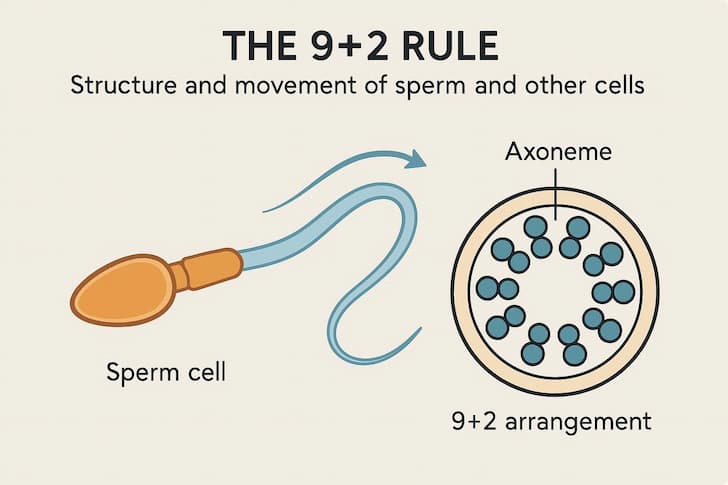
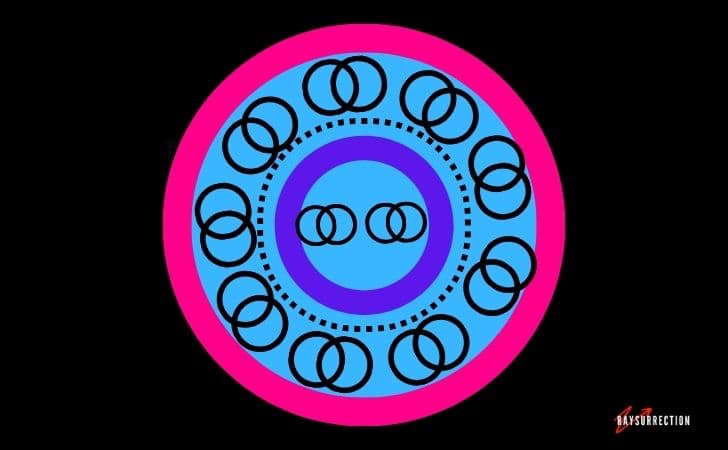
Think of the 9+2 structure like a really small engine. The nine outer pairs of tubes are called microtubules. They're made of protein and sit in a perfect circle. The two tubes in the middle help coordinate everything. Special motor proteins called dyneins stick out from the outer tubes. These dyneins grab onto nearby tubes and pull.
All of this sits inside a thin membrane that connects to the main cell. It's like the cell grew a flexible arm or tail. The whole thing is incredibly small. You'd need a powerful microscope just to see it.
The structure needs support to work right. Spokes connect the outer tubes to the center ones. Links hold the outer tubes together so they don't fly apart. Without these connections, the whole system would fall apart. Everything has to work together perfectly.
The center tubes even spin as the structure moves. Scientists are still figuring out exactly why this happens. But they know it helps make the movement smoother and more coordinated.
How Sperm Use Their Tails
Sperm cells have the most famous example of the 9+2 structure. Their tails are actually flagella that whip back and forth to help them swim. A sperm tail is about as long as the width of a human hair. But it's thousands of times thinner.
When the dynein motors on one side pull harder, that side bends. This creates a wave that travels down the tail from base to tip. The wave pushes against the fluid around it. This creates thrust that moves the sperm forward.
Sperm can swim pretty fast for their size. They move about 25 micrometers per second. That's like a person swimming several miles per hour. The tail has to beat constantly to keep moving forward.
The 9+2 structure makes this swimming very efficient. Sperm can keep swimming for hours without running out of energy. This gives them time to find and fertilize an egg.
How Your Lungs Stay Clean
Your respiratory system has millions of tiny cilia with the 9+2 structure. These are much shorter than sperm tails but just as important. They line your airways from your nose down to your lungs. Their job is to move mucus and trapped dirt out of your body.
These cilia are only about 6-7 micrometers long. But they beat incredibly fast - about 1,000 times per minute when healthy. They all beat in waves, like fans doing "the wave" at a sports game. This creates a current that moves mucus upward.
The beating has two parts. First comes a fast stroke that pushes mucus up toward your throat. Then comes a slower stroke that gets the cilium ready for the next beat. This pattern works like an escalator moving mucus out of your lungs.
When these cilia work properly, you barely notice them. They quietly clean your lungs all day and night. You only realize how important they are when they stop working right.
The Motors That Make It All Work
Dynein proteins are the actual engines of cell movement. They convert chemical energy from ATP into mechanical work. Think of ATP as cellular fuel, like gas for a car. Dyneins are like tiny hands that grab onto microtubules and pull themselves along.
Each dynein goes through a cycle over and over. First it grabs onto a microtubule. Then it changes shape to pull itself forward. Finally it lets go and reaches ahead to grab again. This happens thousands of times per second.
The amazing part is how all these motors coordinate with each other. When motors on one side work harder, the whole structure bends that way. The central tubes and spokes help control this coordination. They make sure the bending creates smooth waves instead of chaotic thrashing.
Recent research shows that calcium and other chemical signals fine-tune how the motors work. This lets cells change their swimming speed and direction. It's like having cruise control and steering for microscopic swimmers.
How All The Motors Work Together
The dyneins don't work alone. There are actually two types - outer arms and inner arms. The outer arms provide most of the power for movement. The inner arms fine-tune the motion and help create the right wave patterns.
Links between the microtubules act like springs. They store energy during one part of the beat cycle. Then they release it during another part. This makes the whole system more efficient.
All of this coordination lets a sperm swim for hours on very little fuel. It also lets your respiratory cilia beat millions of times per day. The teamwork between all these tiny parts is really remarkable.
The whole system is incredibly efficient. Each beat only uses a few molecules of ATP. Compare that to how much energy you need to swim across a pool.
Powering The Cellular Motors
The 9+2 structure needs a steady supply of energy to keep working. Special power stations called mitochondria cluster near the base of cilia and flagella. These mitochondria make ATP from nutrients and oxygen.
The energy efficiency is amazing when you think about it. A sperm cell only has a tiny amount of stored energy. But it can swim continuously for several hours. Your respiratory cilia keep working your entire lifetime.
Cells have backup systems in case something goes wrong. If one mitochondrion breaks down, others can take over. Cells also have repair mechanisms to fix damaged parts of the 9+2 structure.
This reliability is crucial for survival. If sperm couldn't swim properly, reproduction would fail. If respiratory cilia stopped working, lungs would clog up with mucus and debris.
When The System Breaks Down
When The System Breaks Down
Sometimes people are born with genetic problems that affect the 9+2 structure. This condition is called primary ciliary dyskinesia. It affects about 1 in 15,000 people. The cilia and flagella don't form properly or don't move right.
People with this condition get sick a lot. Their respiratory cilia can't clear mucus effectively. This leads to constant coughing and lung infections. The infections can cause permanent lung damage over time.
Men with this condition are usually infertile. Their sperm can't swim properly because the flagella don't work. Some people also have hearing problems because cilia in the ears help with balance and hearing.
The condition affects organ placement too. Special cilia help determine which side of the body organs develop on. About half of people with ciliary problems have their organs arranged backwards.
Figuring Out What's Wrong
Doctors use several tests to diagnose ciliary problems. One simple test measures nitric oxide levels in the nose. Healthy cilia produce this gas, so low levels suggest a problem. This test is quick and doesn't hurt.
For a definitive diagnosis, doctors need tissue samples. They use powerful microscopes to look at the internal structure of cilia. They check whether all the parts of the 9+2 arrangement are present and in the right places.
High-speed cameras can record how cilia move. Doctors can measure the beating frequency and pattern. Even subtle problems with movement show up in these recordings.
Genetic testing is becoming more common too. Scientists have identified many genes that affect ciliary function. Testing can confirm a diagnosis and help predict what symptoms someone might develop.
New Treatments On The Horizon
Scientists are working on gene therapy to fix ciliary problems. The idea is to introduce healthy copies of broken genes into cells. Early experiments in lab animals show promise. But delivering genes specifically to cilia is technically challenging.
Researchers are also looking for drugs that might help. Some compounds can boost the activity of partially working dyneins. Others might help clear mucus even when cilia aren't working perfectly.
Small molecule drugs that increase ciliary beating are another possibility. These wouldn't fix the underlying genetic problem. But they might help reduce symptoms and improve quality of life.
None of these treatments are ready for patients yet. But the research is moving forward rapidly. New discoveries about how cilia work are opening up more treatment possibilities.

New Treatments
Why This Design Has Lasted So Long
The 9+2 arrangement has been around for over a billion years. It's found in everything from human sperm to pond algae. This suggests it's a really good solution for cellular movement. Evolution tends to keep designs that work well and discard ones that don't.
Computer simulations show why the nine-fold pattern works so well. It creates the most efficient wave patterns for swimming through thick fluids. Other arrangements either don't work as well or don't work at all.
The central pair of microtubules seems especially important. They act like a timing system that keeps all the outer parts coordinated. Without them, the movement becomes chaotic and inefficient.
Once cells evolved this complex system, changing it became nearly impossible. All the parts depend on each other. Breaking any one piece usually breaks the whole system. This creates strong pressure to keep the design exactly as it is.
Ancient History Of Cellular Movement
The 9+2 structure evolved very early in the history of complex cells. It developed after cells first got internal membranes and complex protein machinery. This was a major step forward from simpler bacterial systems.
Bacterial flagella work completely differently. They're like tiny propellers driven by rotating motors. Eukaryotic cilia evolved from the internal skeleton and transport systems of more complex cells.
The proteins that make cilia are related to ones that move cargo inside cells. Evolution took existing cellular machinery and repurposed it for movement. This is a common theme in biology - new functions often evolve from old parts.
This evolutionary history helps explain why the 9+2 structure is so conserved. Once cells invested in this complex system, they were stuck with it.
Why Other Designs Failed
Nature has occasionally tried variations on the 9+2 theme. Some specialized cilia lack the central pair and just have the nine outer doublets. But these are used for sensing, not movement. This proves the central pair is needed specifically for creating motion.
Some parasites have evolved modified flagella with extra parts or different spacing. But these variations usually come with trade-offs. They might be more specialized but less efficient overall.
The fact that evolution keeps returning to the 9+2 pattern is telling. It suggests this arrangement represents the best possible solution for cellular motility. Other designs just can't compete.
Even artificial attempts to improve on this design have failed. Engineers trying to build better microscopic swimmers keep coming back to nature's solution.
What Scientists Are Learning Now
New research tools are revolutionizing our understanding of the 9+2 structure. Advanced microscopes can now see individual proteins inside living cilia. Scientists can watch the dynein motors work in real time.
These techniques are revealing layers of complexity that earlier researchers never suspected. The 9+2 structure isn't just a simple motor - it's more like a sophisticated machine with many interacting parts.
This new knowledge is opening up possibilities for treating diseases and developing new technologies. Understanding how the system works is the first step toward fixing it when it breaks.
The research is moving incredibly fast. New discoveries are being made every year. Each one brings us closer to effective treatments for ciliary diseases.
Building Artificial Cilia
Engineers are trying to create artificial versions of the 9+2 structure. These could be used in tiny robots designed to swim through blood vessels. They could deliver drugs to specific parts of the body or remove harmful substances.
The challenge is recreating the complex coordination that makes natural cilia so effective. Current artificial versions are much less efficient than the real thing. But the technology is improving rapidly.
Magnetic and electrical systems can make artificial cilia beat back and forth. But they still can't match the smooth, coordinated waves of natural cilia. This shows just how sophisticated the biological version really is.
Success in this area could lead to revolutionary medical devices. Imagine microscopic robots that could swim through your bloodstream to fight cancer or clear blocked arteries.
Fixing Damaged Tissues
Scientists have discovered that many adult tissues can still grow new cilia. This opens up possibilities for regenerative medicine. Maybe damaged respiratory tissues could be repaired by growing healthy new cilia.
Stem cell therapies might restore functional cilia to people with genetic ciliary diseases. Researchers are also looking for drugs that stimulate cilia growth. These could help repair tissues damaged by infection or injury.
The signaling pathways that control cilia development are complex. But they represent promising targets for new treatments. Understanding these pathways could lead to therapies that restore ciliary function.
This research is still in early stages. But it offers hope for people with currently incurable ciliary diseases.

RANEU Enema Bulb Silicone Anal Douche Enema Kit
- Reusable, non-toxic, and odorless green device. It's a perfect douche.
- The douche kit includes three nozzles. These can be used with most lubricants for anal cleansing.
- To clean, separate the nozzle from the bulb. Rinse it with warm water or soap, then dry all components with a clean cloth.
We earn a commission if you click this link and make a purchase at no additional cost to you.
The 9+2 Rule: Cellular Motors That Keep Life Moving
The 9+2 rule shows how evolution has created an amazing solution to the problem of cellular movement. This tiny motor system powers essential functions throughout our bodies. From sperm swimming to fertilize eggs to cilia keeping our lungs clean, this ancient design continues to be crucial for life.
The precision required for the 9+2 structure to work properly is remarkable. Even small defects in single proteins can cause serious health problems. This highlights just how sophisticated cellular machinery really is.
As we learn more about how cilia work, we gain insights that go far beyond biology. The efficiency and reliability of these cellular motors inspire new approaches to engineering and medicine.
The 9+2 arrangement represents over a billion years of evolutionary refinement. Human technology still struggles to match what evolution has achieved in these microscopic structures. Whether we're treating genetic diseases or designing new medical devices, understanding this cellular masterpiece will continue to benefit humanity for years to come.
