

You look up at the night sky and see a void that devours light itself. Space hides monsters that break every rule of physics we know. Every star eventually faces a fate that leaves researchers scratching their heads in confusion. You often hear about the event horizon, but the real madness happens much deeper inside.
Gravity becomes so intense that reality itself warps into something unrecognizable to the human eye. Light fails to escape the grip of a singularity, creating a dark patch in the cosmos. Your perspective on time changes when you stand near one of those heavy hitters. Seconds stretch into years while the rest of the universe flies past you at high speed.
Scientists work day and night to solve the riddles hidden within the shadows. You will find that the truth is stranger than any science fiction story ever written. Gravity pulls harder than you ever thought possible in the dark.
Cosmic Shadows and the Limits of Light
Light moves at a speed that seems impossible to beat in our daily lives. You probably think of a beam as something that always travels in a straight line. Gravity from a massive object acts like a magnet for those photons. Space bends under the weight of a collapsed star until every path leads inward. You see a black circle because every photon gets trapped in the deep well.
Physics usually follows a set of predictable laws in the normal world. You count on gravity to keep your feet on the ground. Space near a dark star ignores the standard rules of motion. Your atoms would pull apart long before you reached the center of the void. People describe the edge as a point of no return for a reason.
Scientists use the term event horizon to mark the boundary of the dark region. You cannot see what happens inside because no signals ever leave the area. Logic dictates that something exists beyond that curtain of shadow. Mathematics suggests that matter gets crushed into a point of infinite density. You will find that the universe holds secrets that defy every observation we make.
Observe how a flashlight beam bends slightly when it passes a massive planet. You will notice that gravity acts like a lens that distorts your view of the stars.
Watch a clock move slower as it gets closer to a heavy source of mass. You will realize that time is not a constant value in the far reaches of space.
Track the orbit of a star as it whips around an invisible center of gravity. You will identify the presence of a hidden mass that light cannot reveal to you.
Measure the red shift of a signal as it struggles to escape a deep gravity well. You will see how energy drains away from light as it fights to move outward.
Look for the glow of gas as it heats up while falling into the dark void. You will find the outline of a shadow against a background of bright radiation.
How Black Holes Come to Be
Black holes start with a bang - or rather, a collapse. When a massive star, at least eight times bigger than our sun, runs out of fuel, its core can’t hold up against its own gravity. That core crushes down into a super-dense point called a singularity, wrapped in an event horizon that hides it from view. This process creates some of the universe’s wildest gravitational playgrounds.

- Supernova explosions spark stellar-mass black holes. A star 20 times the sun’s mass burns out, and its core implodes. The outer layers blast off in a supernova, while the core becomes a black hole. This event shoots out neutrinos and gamma rays, visible across billions of light-years.
- Primordial black holes might pop up in the early universe. Right after the Big Bang, dense pockets of matter could collapse into tiny black holes. These could be as small as a mountain but super heavy. Scientists think they might explain some of the universe’s missing dark matter.
- Supermassive black holes grow big through mergers. At galaxy centers, these giants, millions to billions of times the sun’s mass, form by merging smaller black holes or gobbling up gas. Quasars, super-bright objects, show how fast they grew long ago.
- Intermediate-mass black holes form from star crashes. In crowded star clusters, stars can smash together, piling up mass. These collisions might create black holes with hundreds to thousands of solar masses. They’re like the middle siblings between small and supermassive black holes.
The Event Horizon and Its Gravitational Tricks
The event horizon is like a black hole’s “no escape” zone - once you cross it, you’re gone from the universe’s view. This boundary warps space and time so much that things get really weird. Time slows down, and gravity bends everything, from light to spaceships. It’s where the black hole’s magic really kicks in.
- Light gets twisted near the event horizon. Photons zipping by a black hole get bent by its gravity, creating wild, warped images of stars or galaxies behind it. This gravitational lensing was captured in the 2019 Messier 87 black hole photo. It’s like a cosmic funhouse mirror!
- Time slows to a crawl close to a black hole. If you’re near the event horizon, your watch ticks way slower than one far away. Someone on Earth would see you moving in slow motion. This time dilation inspired those mind-bending scenes in Interstellar.
- Tidal forces rip things apart. A star getting too close gets stretched and squashed by the black hole’s uneven gravity. This creates a bright flare of light called a tidal disruption event. Astronomers saw one in 2020 when a star got too cozy with a supermassive black hole.
- Gravitational waves burst from black hole collisions. When two black holes merge, they send out ripples in space-time. LIGO detected these waves in 2015 from a pair with 36 and 29 solar masses. It’s like the universe ringing a bell we can “hear”!
The Information Paradox and Quantum Scrambling
Quantum mechanics insists that information stays around forever in the universe. You might think a book is gone if you burn it to ash. Scientists believe you could technically reconstruct the pages if you tracked every atom. Black holes seem to delete that data when they swallow matter. You face a huge problem if the universe loses its memory of what fell inside.
Stephen Hawking proposed that these dark objects eventually disappear over trillions of years. You find yourself in a bind if the object vanishes and takes the data with it. Physics breaks down if cause and effect no longer function in a linear way. Your past becomes a blank slate if the atoms that made you simply stop existing. Researchers call this the information paradox because it threatens the foundation of reality.
Recent theories suggest that the data hides on the surface of the event horizon. You can think of it like a sticker on the outside of a box. Space encodes the three-dimensional interior into a flat two-dimensional skin. Your history stays safe even if you never see the light of day again. You will find that the universe keeps a backup copy of every single particle.
Check the surface area of a dark star to see how much data it holds. You will find that the storage capacity grows as the object gets larger.
Simulate the scramble of particles as they hit the boundary of the void. You will see how the order of atoms turns into a chaotic mess of strings.
Verify the radiation patterns that leak out from the edge of the shadow. You will detect tiny fluctuations that carry the ghosts of fallen matter.
Map the entanglement between the interior and the exterior of the hole. You will observe a ghostly link that connects the inside to the outside world.
Compare the entropy of a star to the entropy of the dark void it creates. You will notice that the void holds far more complexity than the star did.

Hawking Radiation and the Slow Evaporation
Empty space is never actually empty when you look at the quantum level. You will find pairs of particles popping into existence for a split second. Nature usually forces them to crash back together and disappear instantly. One particle sometimes falls into the dark void while the other escapes into space. You see this escaping particle as a faint glow of heat and energy.
Radiation slowly drains the mass of the black hole over a long time. You will wait longer than the age of the universe to see a big one shrink. Small holes disappear much faster because they have a higher temperature. Your tiny primordial hole would explode with the force of a nuclear bomb. Particles fly away until the entire structure vanishes into a puff of light.
Nature hates a vacuum, but it also hates a permanent trap. You will observe that even the strongest grip eventually softens and lets go. Energy must balance out in the end regardless of how much gravity is involved. Your perspective on permanence will shift when you realize nothing lasts forever in the cosmos. You will find that even the darkest pits of space have an expiration date.
Set a sensor near a small black hole to catch the thermal glow. You will measure a temperature that rises as the object loses its total mass.
Calculate the lifespan of a star that has turned into a dark void. You will discover a number that stretches into the trillions of quintillions of years.
Isolate a virtual particle pair near the edge of a gravitational well. You will watch one twin become a real particle while the other vanishes.
Search the deep sky for the bright flashes of dying primordial holes. You will seek signals that tell the story of the very beginning of time.
Estimate the energy output of a shrinking mass as it nears the end. You will find that the final seconds produce a massive burst of gamma rays.
Spaghettification and Tidal Force Extremes
Gravity pulls on your feet harder than your head if you fall feet first. You feel a slight stretch when you stand on a normal planet like Earth. Black holes take this stretching to a level that defies all common logic. Your body will turn into a long, thin strand of atoms before you reach the center. Scientists call this spaghettification because the shape looks like a piece of pasta.
Atoms cannot hold together when the difference in pull becomes too great. You will find your molecules ripping apart into a stream of subatomic particles. Space itself stretches your physical form until you are miles long and inches wide. Your remains join the swirling disc of matter that orbits the dark center. You will find that biology has no place in the heart of a gravitational monster.
Supermassive black holes offer a slightly different experience for a brave traveler. You could cross the horizon of a giant void without feeling any pain at all. Gravity is so large that the difference in pull over your body is tiny. Your doom still waits for you further down the road toward the singularity. You will find that size changes the speed of your eventual destruction.
Drop a probe into a small black hole to watch it stretch out. You will see the metal turn into a wire before the signal cuts out.
Compare the tidal forces of a moon to the pull of a dark star. You will realize that one makes waves while the other shreds planets.
Calculate the point where a human body loses its structural integrity. You will find that the limit occurs long before the event horizon.
Observe the gas clouds that get pulled into long ribbons near the void. You will see the cosmic version of a noodle factory in the sky.
Model the path of an object as it enters the region of high curvature. You will track a spiral that narrows into a single line of matter.
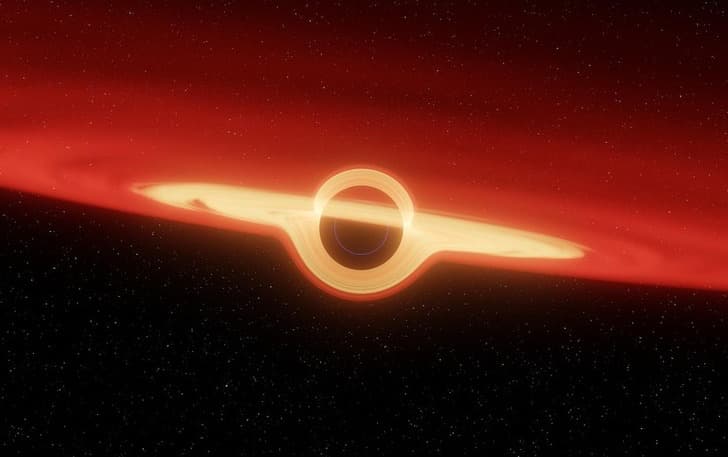
Accretion Disks: Cosmic Light Shows
When matter gets pulled toward a black hole, it doesn’t just fall in - it swirls into a glowing, spinning disk called an accretion disk. The friction in this disk heats things up, blasting out light and energy that can outshine whole galaxies. These disks are like cosmic fireworks powered by gravity. They show how black holes turn matter into dazzling displays.
- Quasars glow from supermassive black holes. Gas spiraling into a huge black hole heats up to millions of degrees, shining in X-rays and visible light. Quasars can be seen from billions of light-years away, outshining entire galaxies. They’re like the universe’s brightest spotlights.
- X-ray binaries light up with stellar-mass black holes. A black hole paired with a star pulls gas from its buddy, forming a hot accretion disk. This disk pumps out X-rays, spotted by telescopes like Chandra. Cygnus X-1, found in 1971, is a classic case of this.
- Jets shoot out super-fast particles. Magnetic fields in the accretion disk launch particles into jets moving almost at light speed. These jets blast out radio waves and gamma rays. The jet from the Messier 87 black hole stretches thousands of light-years.
- Tidal disruption events create temporary disks. A shredded star forms a short-lived accretion disk around a black hole. The disk glows in ultraviolet and X-ray light for months. In 2011, astronomers watched this happen with a star caught by a black hole.
Hawking Radiation: Black Holes Leaking Light
Even black holes aren’t completely “black”! Quantum physics says they can emit tiny bits of radiation, thanks to Stephen Hawking’s ideas. Near the event horizon, particle pairs pop into existence, and sometimes one escapes, carrying energy away. This wild idea hints that black holes might shrink over crazy-long timescales.
- Hawking radiation slowly shrinks black holes. One particle from a pair escapes, stealing a bit of the black hole’s energy. Over billions of years, this could make a black hole evaporate completely. For big ones, though, it’s so slow we’d never notice.
- Tiny black holes vanish faster. If a black hole’s as small as a mountain, it radiates energy much quicker. It could disappear in mere seconds with a burst of energy. We haven’t found these mini black holes, but they’re a cool theory.
- The information paradox puzzles physicists. Information falling into a black hole seems to vanish, which quantum physics doesn’t like. Hawking radiation might carry that info out, but no one’s sure how. This paradox keeps scientists scratching their heads.
- Black hole complementarily tries to solve the puzzle. This idea says outside observers and someone falling in see different things. The observer sees radiation with the info, while the faller crosses the event horizon. It’s a tricky way to make the math work.
The Holographic Principle and Cosmic Projection
Reality might be a projection of a flatter surface at the edge of space. You think you live in a world with height, width, and depth. Mathematics suggests that the third dimension is an illusion created by flat data. Black holes provide the best evidence for this strange view of the physical world. Your volume seems to be less real than the surface area of the void.
Data on the event horizon describes everything that ever fell into the hole. You will find that the horizon acts like a screen for a cosmic movie. Gravity emerges from the way this information interacts on the boundary of space. Your physical presence could be a shadow of a more basic layer of reality. Researchers study this principle to find a way to link gravity with quantum laws.
Physics works perfectly if we treat the universe like a giant hologram. You will find that the math gets simpler when you remove one dimension. Space time emerges from the patterns of data stored on the cosmic rim. Your perception of depth is just a convenient way for your brain to process the code. You will find that the true nature of the world is much flatter than it looks.
Measure the entropy of a system by looking at its surface area. You will find that the interior content is limited by the outer boundary.
Create a mathematical model of a universe with only two dimensions. You will see that gravity still appears as a force in the projection.
Trace the links between distant particles on the shell of a dark void. You will identify the connections that build the 3D world you know.
Examine the pixels of space at the smallest possible scale of reality. You will look for the graininess that suggests a projected image.
Project a light through a data crystal to see a solid shape appear. You will simulate the way the universe builds a world from flat code.
Kerr Black Holes and Frame Dragging
Most stars spin as they collapse into a dark and heavy void. You will find that this rotation creates a ring singularity instead of a point. Space around a spinning black hole gets dragged along like water in a whirlpool. Scientists call this frame dragging because the fabric of reality twists around the mass. Your path through space gets forced into a spiral by the spinning dark star.
Rotation creates a region called the ergosphere just outside the event horizon. You could technically steal energy from the hole if you enter this zone. Objects that fly in and split apart can exit with more speed than they had. Your ship would gain massive amounts of kinetic energy from the spin of the void. You will find that the rotation of the cosmos can be a source of power.
Space time becomes a turbulent ocean near a spinning Kerr black hole. You will find it impossible to stay still even if you have a rocket. Motion is mandatory in the ergosphere because the vacuum itself is moving. Your ship will whip around the center at a large fraction of light speed. You will find that the spin of a star defines the shape of the dark void.
Launch a satellite into the ergosphere to test for a boost in speed. You will observe the Penrose process in action as the craft accelerates.
Measure the shift in the stars behind a spinning gravitational mass. You will see the twisting of light as the space fabric rotates.
Model the ring singularity to see if a path exists through the center. You will find that the math allows for a passage to another place.
Track the jets of plasma that shoot out from the poles of the void. You will identify the magnetic fields created by the intense rotation.
Calculate the maximum spin rate before the event horizon disappears. You will discover a limit that prevents a naked singularity from forming.
The Firewall Hypothesis at the Horizon
General relativity says you should feel nothing as you cross the event horizon. You would simply float through the dark curtain toward your eventual doom. Quantum theory suggests a much more violent end at the boundary of the void. A wall of high energy particles might burn you to a crisp instantly. Your entry into the black hole could be a sudden flash of heat.
Conflict between gravity and quantum rules creates this theoretical wall of fire. You will find that the horizon might be a place of extreme temperature. Entanglement between particles gets broken at the edge of the dark region. Breaking these links releases a massive amount of energy into the surrounding space. You would turn into ash before you ever saw the inside of the hole.
Researchers argue about which theory is correct for a traveler in space. You might find that the firewall is the only way to save quantum mechanics. Physics requires a trade-off between smooth space and conserved information. Your death would be quick and hot if the firewall exists at the edge. You will find that the boundary of a void is the most dangerous place in the sky.
Simulate the break in particle entanglement at the event horizon. You will calculate the thermal energy released during the disconnection.
Search for high energy signatures coming from the edges of distant voids. You will look for the glow of the firewall in the cosmic background.
Compare the predictions of Einstein with the new quantum models. You will see where the two great theories clash over your fate.
Test the equivalence principle with a virtual observer near a dark star. You will determine if the observer feels the heat of the boundary.
Model the cooling of a black hole as it interacts with the firewall. You will find that the wall affects the rate of Hawking radiation.
Wormholes and Einstein-Rosen Bridges
Einstein once described a bridge that could link two distant points in space. You would enter a black hole and exit through a white hole elsewhere. These tunnels could allow for travel across the galaxy in a single second. Mathematics allows for these shortcuts even if we have never seen one. Your trip would bypass the millions of years of travel time in normal space.
Keeping a wormhole open requires a special kind of exotic matter. You would need something with negative energy to prop the walls of the tube. Normal gravity wants to crush the tunnel shut before you can get through. Your ship would be trapped in the middle if the bridge collapsed on you. You will find that the laws of nature are very picky about shortcuts.
Wormholes might be a natural part of the quantum foam at the smallest scale. You could find tiny tunnels connecting every single atom in the universe. Scaling these up to a size for humans is the real engineering trick. Your perspective on distance would vanish if you could step through a door. You will find that the map of the universe is full of hidden paths.
Search for pairs of black holes that share a single quantum state. You will identify the potential ends of a stable cosmic wormhole.
Calculate the amount of negative energy needed to stabilize a tunnel. You will find that the requirement exceeds the mass of a planet.
Simulate a light signal passing through a shortcut in the space fabric. You will measure the time saved compared to the standard path.
Look for double images of stars that might signal a lens in the tunnel. You will seek visual proof of a bridge between distant galaxies.
Model the causality loops that occur if a wormhole allows time travel. You will find that the universe has ways to prevent paradoxes.
Primordial Black Holes from the Early Universe
Most black holes form from the death of a very large star. You might find some that were born just seconds after the Big Bang. Extreme pressure in the early universe could have crushed gas into tiny voids. These primordial objects would range from the size of an atom to a mountain. Your neighborhood might be full of these invisible leftovers from the dawn of time.
Dark matter could actually be made of these small black holes. You would see their gravity affecting the way galaxies spin and move. They do not emit any light, which makes them very hard to find. Your telescope will only see them if they pass in front of a distant star. You will find that the oldest things in the universe are still hiding from us.
Small primordial holes eventually evaporate through the process of Hawking radiation. You would see a massive burst of light when one finally disappears. This explosion tells us exactly what the universe was like in its first moments. Your search for these events could unlock the history of the entire cosmos. You will find that the smallest voids carry the biggest secrets.
Scan the gamma ray background for the signature of a dying mini hole. You will detect the final scream of an object from the beginning of time.
Monitor the brightness of a star for a sudden micro lensing event. You will find the shadow of a small mass passing through the light.
Calculate the density of the universe during the first microsecond. You will determine the conditions needed to create a primordial void.
Track the orbits of small asteroids in the outer solar system. You will look for a tiny pull that suggests a hidden dark mass.
Compare the distribution of dark matter to the theory of mini holes. You will see if the numbers match the observations of the sky.
White Holes and Time Reversal
Mathematics suggests that a mirror version of a black hole must exist. You would see a white hole that spits out matter and light constantly. Nothing can ever enter the event horizon of one of these bright objects. Your ship would be pushed away by an unstoppable force of outward motion. They are essentially black holes running backward through the flow of time.
White holes might be the exit point for everything that falls into a dark void. You would fall into a sink and come out through a fountain in another place. This theory connects the birth and death of matter in a closed loop. Your atoms would re-emerge in a different part of the universe or a new era. You will find that the symmetry of physics is a beautiful and strange thing.
Nobody has ever found a white hole in the vastness of the night sky. You might find that they are too unstable to last for more than a second. Some scientists think the Big Bang was the ultimate white hole event. Your entire existence could be the result of a massive ejection from a void. You will find that the origin of everything is tied to the dark.
Search for sudden bursts of matter that appear from an empty spot. You will look for the signature of a fountain in the deep cosmos.
Reverse the equations of a collapsing star to see the expansion. You will find a mathematical proof for the existence of the white hole.
Analyze the light of a quasar to see if it fits the white hole model. You will compare the energy output to the theory of outward flow.
Model the transition from a dark singularity to a bright ejection. You will track the path of a particle through the center of time.
Estimate the lifespan of a white hole in a turbulent quantum field. You will find that they likely vanish as fast as they appear.

If You Fell Into a Black Hole
Picture yourself in a spaceship drifting too close to a black hole - what happens next? As a human, your fate depends on the black hole’s size and your distance from it. The intense gravity would make for a wild, one-way ride. Here’s a friendly breakdown of what you’d experience, step by step.
- Tidal forces would stretch you like spaghetti. Near the event horizon of a stellar-mass black hole, gravity pulls harder on your feet than your head. This “spaghettification” would stretch you into a long, thin shape. It’d be over in milliseconds, and sadly, you wouldn’t survive. For a supermassive black hole, the effect is gentler, letting you cross the event horizon before it kicks in.
- Time would get super weird for you. As you approach the event horizon, time slows down relative to the outside universe. To someone watching from far away, you’d seem to freeze in time, never quite crossing. But from your perspective, you’d fall through normally, unaware of the slowdown.
- You’d vanish beyond the event horizon. Once you cross that boundary, no signal from you could reach the outside world. Light, radio waves, or any message you send gets trapped. To the universe, you’re gone, even if you’re still experiencing your fall. It’s like stepping behind an invisible curtain.
- The singularity would be your final stop. At the black hole’s center lies the singularity, a point of infinite density. Physics as we know it breaks down here, so we can’t say exactly what happens. You’d likely be crushed into an unimaginably tiny space. It’s a cosmic mystery we can’t yet solve!
The No-Hair Theorem and Stellar Simplicity
Black holes are surprisingly simple objects when you look at their properties. You only need to know their mass, their spin, and their electric charge. Every other detail about the star that formed them vanishes into the dark. Scientists call this the no-hair theorem because the void has no extra features. Your complex history is reduced to three simple numbers once you fall inside.
Identity is lost when gravity crushes matter into a single point. You could make a black hole out of gold or out of old socks. The resulting void would look exactly the same to an outside observer. Your gold atoms would be indistinguishable from the carbon in the dirty laundry. You will find that the universe is a master of simplification.
Exceptions to this rule are a hot topic in the world of theoretical physics. You might find that tiny "hairs" of quantum data exist near the horizon. These traces would hold the information needed to solve the paradox of lost data. Your legacy would survive in the form of a faint quantum signature. You will find that even the simplest objects have a hidden layer of depth.
Measure the magnetic field of a black hole to check for extra traits. You will find that only the charge and spin create a field.
Compare two black holes with the same mass but different origins. You will observe that they appear identical in every measurable way.
Calculate the gravitational waves produced by a merging pair of voids. You will look for the "ringdown" that confirms the simple nature of the mass.
Simulate the collapse of a star with a complex shape and rotation. You will see the irregularities vanish as the event horizon forms.
Search for quantum fluctuations that suggest a "fuzzy" boundary. You will seek proof that information is not completely erased by gravity.
We earn a commission if you click any of these links and make a purchase at no additional cost to you.


Supermassive Giants at Galactic Hearts
Every large galaxy seems to have a monster living in its very center. You will find a black hole with millions or billions of times the mass of the Sun. These giants control the movement of stars for thousands of light years. Your own Milky Way has a heavy hitter called Sagittarius A* in its core. You will find that the heart of our home is a dark and heavy place.
Growth happens as these giants swallow gas and entire stars over eons. You will see a bright disc of fire as the matter heats up before the fall. This process makes the center of some galaxies the brightest spots in space. Your view of a galaxy is defined by the activity of its central void. You will find that destruction is the engine of cosmic light.
Scientists still wonder how these massive objects grew so large so fast. You might find that they formed from the merger of smaller black holes. The early universe must have had the perfect conditions for these giants to thrive. Your understanding of galactic history depends on the study of these dark cores. You will find that the giants are the anchors of the modern universe.
Track the orbits of stars near the center of the Milky Way. You will calculate the mass of the invisible object they are circling.
Observe the radio waves coming from the accretion disc of a giant. You will see the heat generated by matter as it nears the edge.
Compare the size of a galaxy to the mass of its central black hole. You will notice a link that suggests they grew up together.
Look for the shadow of a supermassive void using a global telescope. You will see the first direct image of the dark heart of a galaxy.
Model the collision of two galaxies and their central black holes. You will predict the massive gravitational waves created by the event.
Gravitational Lensing and Light Bending
Gravity acts like a giant magnifying glass in the middle of deep space. You will see light from distant stars curving around a heavy black hole. This effect creates multiple images or bright rings in your telescope view. Space itself is the lens that distorts the path of the incoming photons. Your perspective on the position of stars changes when a void is in the way.
Einstein predicted this bending of light long before we had the tools to see it. You can use this lensing to find black holes that are otherwise invisible. The background stars will suddenly jump or brighten as the dark mass passes. Your search for dark matter relies on this trick of gravitational physics. You will find that the shadows of the universe can reveal the light.
Lensing also allows us to see things that are much further away than normal. You get a boost in your vision from the natural curvature of the cosmos. This cosmic telescope helps us peer back into the very beginning of time. Your view of the edge of the universe is improved by the gravity of the dark. You will find that the void is a window into the distant past.
Identify an Einstein Ring in a high resolution image of deep space. You will see a perfect circle of light around a dark center.
Calculate the mass of a lensing object by measuring the light shift. You will determine the weight of a void you cannot see directly.
Look for the flickering of a quasar as it is lensed by a passing mass. You will track the change in brightness over several weeks.
Simulate the distortion of a grid of stars behind a gravitational well. You will visualize the warping of space as light moves through it.
Compare the real position of a star to its apparent position near a hole. You will measure the angle of the light as it bends in the dark.
Time Dilation and the Frozen Star Effect
Time slows down as you get closer to a source of extreme gravity. You will find that your watch ticks slower than the watch of someone on Earth. Near the event horizon, time practically grinds to a complete halt for you. Your friends back home will age and die while you only experience a few seconds. You will find that the dark void is a natural time machine to the future.
An outside observer will never actually see you fall into the black hole. You will appear to slow down and turn red as you reach the boundary. Your image will eventually freeze at the edge and fade away into nothingness. You look like a "frozen star" to anyone watching from a safe distance. Your reality is much different as you fall through the horizon at high speed.
Difference in the flow of time creates a strange disconnection between two people. You will see the entire history of the universe flash before your eyes in a moment. Light from the future falls in with you, giving you a glimpse of the end. Your experience is a private journey that nobody else can ever share with you. You will find that gravity is the master of the clock.
Sync two atomic clocks and place one near a massive celestial body. You will measure a tiny difference in time after only a few days.
Calculate the time shift for a traveler sitting near a supermassive void. You will find that one hour equals seven years on a distant planet.
Observe the frequency of light as it leaves the edge of a gravitational well. You will see the waves stretch out as time slows down for the source.
Model the path of a photon as it orbits a dark star in the photon sphere. You will find that light can stay in one place for an eternity.
Estimate the age of a black hole from the perspective of its singularity. You will discover that for the hole, the end happens in an instant.
The Penrose Process and Energy Extraction
Spinning black holes have a zone where the vacuum of space is moving. You will find that this ergosphere allows for a clever way to steal energy. If you throw an object in and let it split, one part falls in while the other escapes. The part that escapes carries away some of the rotational energy of the void. Your ship could use this method to reach incredible speeds without using fuel.
Nature allows us to harvest the spin of a star to power a civilization. You would build a massive ring around the black hole to catch the outgoing energy. This process would eventually slow the rotation of the hole until it stops. Your power source would last as long as the spin of the dark object remains. You will find that the universe is full of free energy if you are brave.
Black hole bombs are another theoretical way to use this intense gravity. You would surround the hole with mirrors and bounce light through the ergosphere. Every pass would amplify the light until it reaches a massive level of power. Your mirror cage would eventually explode with the force of a million suns. You will find that the dark holds a dangerous amount of potential.
Simulate the trajectory of a debris cloud through a spinning ergosphere. You will calculate the energy boost as the debris exits the zone.
Design a theoretical power plant that orbits a rotating dark star. You will map the flow of energy from the spin to the collection grid.
Measure the slowing of a pulsar as it interacts with a nearby void. You will look for signs of energy transfer between the two objects.
Calculate the maximum energy you could extract from a Kerr black hole. You will find that you can take up to twenty-nine percent of its mass energy.
Model the amplification of electromagnetic waves in a mirror trap. You will see the energy density rise with every bounce through the spin zone.
We earn a commission if you click any of these links and make a purchase at no additional cost to you.

The Masters of Limitation: An ET's Observations of Earth
By Darryl Anka (Bashar)
"Not only a unique perspective of human society and our place in the universe, but also gifts us with life-changing information that can profoundly alter our view of reality."
Black Holes and the Universe’s Story
Black holes aren’t just cool - they help shape the universe! Their gravity pulls galaxies together, and their energy can stop stars from forming. They’re like cosmic architects, influencing how the universe looks. Studying them also tests our biggest physics ideas.
- Supermassive black holes steer galaxy growth. They sit at galaxy centers, holding stars in orbit. Their jets and radiation can heat up gas, slowing star formation. The Milky Way’s Sagittarius A* is a perfect case of this.
- Mergers make black holes bigger. When galaxies collide, their black holes often merge, growing in mass. This sends out gravitational waves we can detect. LIGO’s 2015 discovery showed two black holes becoming one.
- Black holes test Einstein’s ideas. Their intense gravity is a great place to check general relativity. Effects like lensing and time dilation match Einstein’s predictions perfectly. The 2019 Messier 87 image proved this in stunning detail.
- Early black holes might spark galaxies. In the young universe, black holes could pull in gas, kickstarting stars. Quasars from billions of years ago hint at this. They might be the seeds that grew today’s galaxies.
Black Hole Mysteries Unraveled
Black holes are mind-blowing, from their gravity-defying tricks to the wild idea of you falling into one! They’re key players in the universe’s story, shaping galaxies and testing physics. New telescopes and experiments keep revealing more about them. So, next time you look at the stars, think of these cosmic giants and the adventures they hold!
