

Welcome to the weirdly addictive world of object manipulation where physics meets hand-eye coordination. Gravity acts as a constant opponent in this arena, yet humans possess the dexterity to overcome its pull with enough repetition.
Gravity won't give you a break, so your focus stays locked on the flight paths of your spheres. Most beginners start with heavy expectations, but the secret lies in the rhythm of the throw rather than the speed of the catch. Your brain will rewire itself as you track multiple objects across your field of vision simultaneously.
Perfection remains a distant peak, while the actual fun happens during the drops and fumbles. Every professional started with a single drop on a dusty floor. Pick up your gear and prepare for a rewarding afternoon of manual labor. Success arrives in small increments of seconds where the air holds more balls than your hands do.
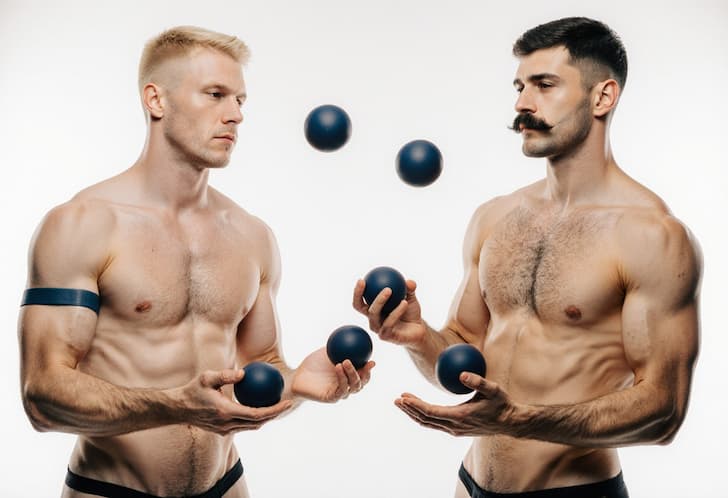
Pick the Best Spheres for Success
Soft beanbags stay put when they hit the hardwood. Your hands prefer a surface with some grip to prevent accidental slips. Tennis balls often bounce away too quickly for a novice. Professional juggling balls utilize millet or plastic pellets to deaden the impact. Your progress depends heavily on gear that refuses to roll under the furniture.
Size dictates how many objects fit into your palm comfortably. Large spheres obstruct your view during the peak of the arc. Small marbles slip through the gaps between your fingers. Standard sizes usually hover around sixty-five millimeters for average adult hands. You will notice immediate improvement once the equipment fits your physical dimensions.
Weight affects the muscle memory you develop over hours of practice. Light objects drift with every tiny gust of air or hand tremor. Heavy balls fatigue your forearms within minutes of starting. Aim for a weight between one hundred and one hundred thirty grams. Proper mass helps your brain track the arc without conscious effort.
Fill a balloon with flour to create homemade juggling beanbags. The weight provides a satisfying thud in your palm.
Opt for underfilled leather pouches to avoid the rolling problem. Dead drops save you from constant bending and stretching to retrieve your gear.
Select bright colors to make tracking easier against dark walls. High contrast helps your eyes stay focused on the peak of the throw.
Master the Basic Stance and Grip
Stand with your feet shoulder-width apart to ensure a solid base. Your elbows should stay tucked near your ribcage like you are holding a newspaper. Tension ruins the fluid motion required for a steady rhythm. Relax your shoulders and let your arms hang naturally before you begin. Stability starts at the floor and moves up through your torso.
Palms face upward to receive the descending objects safely. Your fingers stay loose rather than clenched in a tight fist. Position your forearms parallel to the ground to maximize your catch zone. Any stiff movements result in erratic throws that fly toward the ceiling. Soft hands act like shock absorbers for the falling mass.
Look straight ahead rather than staring directly at your hands. Your peripheral vision handles the catching while your focus stays on the peak. Head movements disrupt your internal sense of where the balls go. Keep your chin level and breathe steadily through your nose. Focused eyes track the intersection of the two arcs above your head.
Keep your elbows locked at a ninety-degree angle. Excessive arm movement introduces too many variables into the flight path of the ball.
Maintain a slight bend in your knees to absorb the rhythm. Rigid legs make your upper body feel stiff and unresponsive to quick changes.
Position your hands about six inches away from your hips. The space allows for a full range of motion without hitting your belt or clothes.

The Single Ball Arc Technique
Start with one object to build a consistent throwing height. Toss the ball from your dominant hand to your non-dominant hand. The peak of the throw should reach the level of your forehead. Consistency in height ensures you have time to react later. Your hand follows a small scooping motion toward the center of your body.
Focus on the release point rather than the catch itself. The ball leaves your hand when your arm reaches the middle of its upward swing. A common mistake involves throwing the ball too far forward. Your target stays in an imaginary plane right in front of your face. Repeated tosses build the neural pathways for a perfect arc.
Reverse the direction to train your weaker hand immediately. Most people struggle with their non-dominant side during the first hour. Practice until the arc looks identical regardless of which hand starts. Symmetry prevents lopsided patterns once you add more objects. Accuracy beats speed during every stage of this manual labor.
Throw the ball in a scoop motion toward your navel. The circular path creates the space for the next object to move.
Watch the ball reach its highest point before moving your other hand. Patience prevents premature reaching and missed catches.
Aim for an imaginary box just above your eye level. Consistent targets make the transition to two balls much smoother for your brain.
Transitioning to the Two Ball Exchange
Hold one ball in each hand to prepare for the exchange. Throw the first ball from your dominant hand toward the opposite side. Wait until that ball reaches its peak before throwing the second one. The second ball travels underneath the first ball in a mirror image. Your hands perform a throw-throw-catch-catch sequence.
Rhythm dictates the success of this two-part movement. Count out loud to maintain a steady beat during the process. Avoid the urge to pass the ball across your waist. The cross-body pass ruins the geometry of the three-ball pattern. Your focus stays on the two peaks in the air.
Swap the starting hand to build equal strength across both arms. Beginners often favor their right hand and neglect the left. A weak left hand causes the entire pattern to drift sideways. Practice the exchange until the balls land softly in your palms. Smooth transitions indicate you are ready for the full pattern.
Say "one, two" as each ball leaves your hand. Auditory cues help your brain synchronize the motor functions required for success.
Prevent the shower habit where you pass the ball horizontally. Horizontal passes create a circle that is harder to maintain than a cascade.
Catch the second ball at the same height as the first. Even catches mean your throws remain consistent and controlled.
Launching the Three Ball Cascade
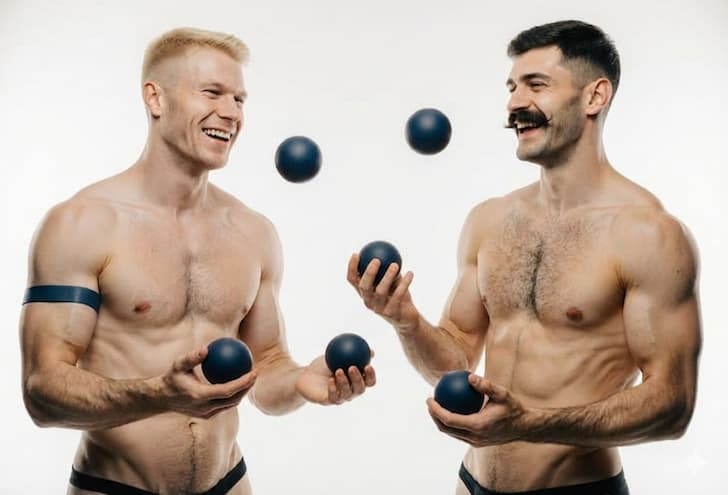
Place two balls in your dominant hand and one in the other. Your dominant hand starts the sequence with the front ball. Throw the first ball and wait for it to peak. Release the second ball from the opposite hand as the first descends. The third ball follows once the second ball reaches its highest point.
Success depends on the "throw, throw, throw" mentality without worrying about catches. Your brain will eventually learn to catch if the throws stay accurate. Most learners stop after two throws because of a mental block. Push through the desire to stop and keep the air filled. Gravity works against you, but the rhythm keeps things moving.
Keep the pattern narrow to avoid chasing balls around the room. Wide throws force you to move your feet and lose your stance. A compact cascade stays within the width of your shoulders. Practice over a bed to minimize the distance you reach for drops. Fatigue sets in quickly, so take short breaks every ten minutes.
Focus on the empty hand rule during the rotation. You always throw the ball from the hand that is about to receive one.
Count to three and then stop to master the flash. A flash consists of three throws and three catches in a row.
Extend your count to four as you gain more confidence. Gradual increases prevent the frustration of constant failure.
Correcting Common Trajectory Errors
Forward drifting happens when you release the ball too late. Your hands naturally want to push objects away from your body. Step against a wall to force your throws into a vertical plane. The wall acts as a physical boundary for your hands and balls. Constant correction will eventually fix your muscle memory.
Uneven heights cause the balls to collide in mid-air. One ball often flies higher than the rest due to arm strength. Monitor the peak of every throw to ensure they match perfectly. Collisions usually end the run and send spheres flying across the floor. Adjust your force until the rhythm feels completely symmetrical.
Tucking your elbows helps prevent the chasing phenomenon. Many people walk forward as they juggle because of poor release points. Stand still and let the balls fall if they go too far. Picking them up is better than developing a walking habit. Proper form remains the most valuable asset for any juggler.
Practice in front of a mirror to see your own mistakes. Visual feedback identifies lopsided arm movements instantly.
Use a wall to limit the forward motion of your throws. Standing close to a flat surface forces a vertical pattern.
Lower your throw height if you feel rushed or panicked. Short arcs give you less time but offer more control in tight spaces.
Exploring Early Variations and Tricks
The Half-Shower involves throwing one ball over the top of the others. You maintain the cascade pattern with two balls while the third arcs higher. This trick requires a slightly harder throw from one side only. Your hand moves in a wider circle to clear the existing pattern. Practice the over-the-top throw with a single ball first.
Jugglery Tennis uses one ball that always travels over the top. The tennis ball bounces back and forth across the peak of the cascade. You must track the specific color of the high ball among the others. This variation improves your ability to distinguish between different flight paths. Your eyes will get a workout as they jump between heights.
Under the Arm tosses add a layer of complexity to your routine. You reach under your opposite forearm to release the ball upward. The movement feels awkward until your flexibility improves with repetition. Start by attempting just one under-the-arm throw per cycle. Mastery of these small tweaks leads to more advanced multi-ball patterns.
Try the Claw catch by grabbing balls from above. Reversing your palm orientation changes the entire feel of the catch.
Experiment with high throws to give yourself a breather. A momentary high arc buys you time to reset your hand position.
Add a single spin to one ball for visual flair. Spinning the ball as it leaves your hand adds a professional touch.
The Physics of the Cascade Pattern
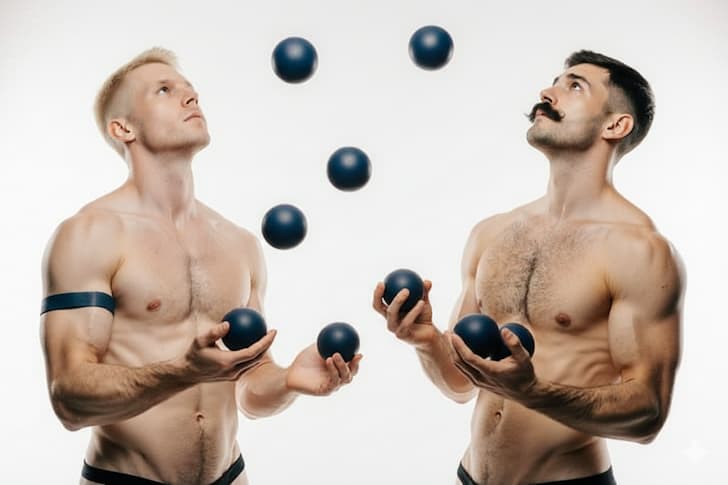
Gravity pulls every object toward the center of the earth at a constant rate. Your throws must counteract this force with enough upward velocity to create hang time. Hang time represents the duration a ball stays in the air before your hand catches it. Faster throws result in higher peaks and more time to process the next move. Math dictates that higher throws allow for more objects to enter the pattern.
Parabolic arcs provide the most stable path for a juggling ball. Your hand creates an elliptical motion to launch the ball from the inside to the outside. The ball follows a curve that peaks exactly between your two hands. Symmetry in these arcs prevents the balls from colliding at the center point. Every throw follows the laws of projectile motion without exception.
Air resistance plays a minor role when you use heavy beanbags. Wind becomes a factor only when you practice outdoors with lightweight spheres. Most indoor environments provide a vacuum-like consistency for your practice sessions. Consistent atmospheric conditions help your muscles learn the exact force required for every toss. Physics ensures that every ball returns to the height of your hand.
Observe how the balls cross at the midpoint of their flight. The intersection creates a visual "X" that helps you time your next release.
Notice the weightless feeling at the very top of the arc. This split second gives your eyes the data needed to predict the landing spot.
Calculate the force needed by practicing throws of different heights. Varying the intensity teaches your nervous system to adjust for different tempos.
Brain Training and Neuroplasticity
Peripheral vision expands as you learn to track multiple moving targets. Your brain stops looking at individual balls and starts seeing the whole pattern. This shift in perception allows you to react faster to unexpected deviations. Habituation reduces the mental load required to maintain the three-ball cascade. Eventually, the movement becomes as natural as walking or breathing.
White matter in the brain increases after several weeks of consistent juggling practice. Researchers found that the visual-motor areas expand to accommodate the new skill. Your brain builds better connections between the left and right hemispheres. These neural upgrades persist even if you stop practicing for a few months. Learning a physical skill changes the actual structure of your grey matter.
Mental fatigue often arrives before your muscles actually give out. Your nervous system works overtime to process the high-speed visual data. Short sessions of fifteen minutes prove more productive than marathons of two hours. Sleep helps consolidate the motor patterns you learned during the day. You will often wake up better at juggling than you were the night before.
Listen to a steady metronome to train your internal clock. Synchronizing your throws to a beat speeds up the habituation process.
Close one eye to test your depth perception during single tosses. Monocular practice forces the brain to rely on different spatial cues.
State the color of each ball as it reaches its peak. Verbalizing the visual data keeps your mind fully present in the moment.

Stretching and Physical Maintenance
Wrist flexibility prevents the onset of strain during long practice hours. Rotate your hands in circles to warm up the connective tissues. Tight forearms lead to jerky movements and poor throw accuracy. Gentle stretches ensure your muscles remain supple and ready for quick reactions. Blood flow to the extremities improves your overall coordination.
Back muscles support your posture while you stand for extended periods. Your core stays engaged to maintain a level platform for your arms. Slumping forward restricts your lung capacity and reduces your focus. A tall spine allows your shoulders to move through their full range. Strength in the posterior chain helps you stay still while the balls move.
Finger dexterity improves with small exercises away from the juggling balls. Squeeze a soft stress ball to build the grip strength needed for catches. Quick finger taps on a table help increase your reaction speed. Hydration keeps your joints lubricated and your mind sharp during the session. Healthy habits outside of practice translate to better performance with the spheres.
Pull your fingers back toward your wrist for a deep forearm stretch. This movement releases tension built up from hundreds of repetitive catches.
Shake your arms out completely between every five minutes of practice. Resetting the muscles prevents the "stiff arm" syndrome that ruins rhythm.
Stand on a foam pad to improve your core stability. An unstable surface forces your body to work harder to maintain a solid base.
Setting Up Your Practice Space
High ceilings allow for taller throws and more reaction time. Avoid rooms with low-hanging light fixtures or ceiling fans. A clear space prevents you from breaking household items during a wild toss. Your environment should feel open and free of immediate distractions. Enough room to take a step in any direction is a requirement.
Lighting should be bright and come from multiple angles. Shadows on the wall can confuse your depth perception during fast patterns. Avoid practicing directly under a single harsh bulb that creates a glare. Natural light from a window provides the best visibility for tracking dark objects. Clear sightlines help your brain process the flight path without strain.
Floor surfaces determine how much you have to chase dropped balls. Carpet prevents balls from rolling away but can be hard on your feet. Hardwood floors make for easy cleanup but require balls that don't bounce. A yoga mat provides the perfect middle ground for grip and ball control. The right surface makes the inevitable drops much less annoying.
Remove all fragile items from the immediate vicinity of your arms. Clear zones prevent accidents when a throw goes sideways.
Practice in front of a plain wall to reduce visual clutter. A simple background makes it easier for your eyes to lock onto the spheres.
Set a timer to ensure you take regular breaks. Structured practice prevents the burnout associated with repetitive physical tasks.
Mastering Tempo and Speed Control
Slow juggling requires high throws that give you several seconds of air time. This style looks majestic and allows for more body movement. Fast juggling relies on short, quick pulses that stay near your chest. You will need to switch between these tempos to develop full mastery. Each speed requires a different level of grip pressure and arm tension.
Gravity remains constant, so you must adjust your force to change the speed. Higher energy throws translate into a slower catch rhythm. Lower energy tosses force your hands to move with lightning speed. Most beginners find a medium tempo easiest to maintain during the first week. Variety in your practice prevents you from becoming a one-speed juggler.
Counting the beats helps you identify when your tempo starts to drift. You might notice your right hand throwing faster than your left. Correcting these micro-variations requires conscious effort and steady breathing. Use a music track with a clear drum beat to guide your hands. Music provides a natural structure for your physical exercise.
Practice throwing balls at different heights in the same session. Height control is the secret to moving into advanced patterns.
Try to juggle as slowly as possible without dropping. Slow-motion practice highlights the flaws in your release points.
Speed up your pattern for ten seconds and then return to normal. Bursts of speed build the fast-twitch muscle fibers in your forearms.
The Mental Game of Object Manipulation
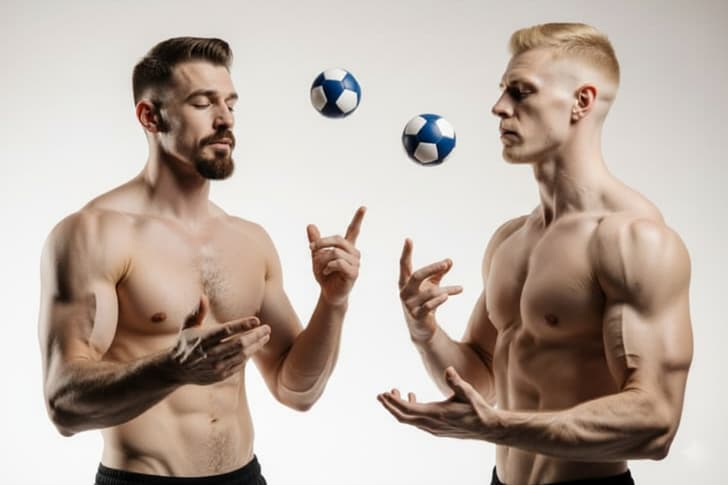
Frustration serves as the primary barrier for most new students. Your mind wants to succeed immediately, but your muscles require time to adapt. Accept that dropping the ball is a necessary part of the learning curve. Each mistake provides a data point for your brain to process. A calm mind reacts faster than a panicked one during a collision.
Focus on the space between the balls rather than the balls themselves. This "void" perspective helps you see the pattern as a single unit. Distractions in the room will try to pull your eyes away from the peak. Tunnel vision helps you maintain the cascade during longer runs. Silence or white noise can help you stay in the zone.
Confidence grows with every successful catch you make. Small victories like a five-throw run should be acknowledged mentally. You will experience plateaus where progress seems to stop for a few days. These periods usually precede a major breakthrough in your skill level. Consistency over weeks beats intensity over a single weekend.
Close your eyes for a split second to test your internal rhythm. Blind juggling relies entirely on muscle memory and feel.
Practice while talking to a friend to build subconscious control. Distracted juggling proves that the skill has moved into your long-term memory.
Visualize the balls moving in a perfect circle before you start. Mental rehearsal primes your nervous system for the actual movement.
Transitioning to Different Objects
Clubs require a completely different grip and release technique compared to balls. The weight distribution in a club means you must account for rotation. Rings offer a flat surface that is easy to catch but hard to throw accurately. Every new object forces your brain to recalibrate its spatial map. Mastering balls provides the base for all other prop types.
Everyday items like fruit or rolled-up socks provide a fun diversion. Be careful with fragile items that might break upon impact with the floor. Oddly shaped objects introduce unpredictable aerodynamics into your practice. Your hands will learn to adapt to various textures and weights. This versatility makes you a more skilled manipulator of the physical world.
Heavy objects like medicine balls build significant strength in your shoulders. Do not attempt to juggle heavy items until your form is perfect. Light items like scarves move through the air with exaggerated slowness. Scarves are excellent for teaching the cross-hand motion to absolute beginners. Each prop offers a lesson in how physics affects different materials.
Try juggling three different objects at the same time. Asymmetric juggling forces your brain to process different weights simultaneously.
Use small stones to practice the precision required for tiny targets. Small objects require much tighter finger control and better vision.
Experiment with scarves if you find the balls move too fast. The slow descent of fabric gives you plenty of time to plan your moves.
Building a Consistent Practice Routine
Ten minutes of daily practice is better than one hour once a week. Your brain needs regular reinforcement to keep the neural pathways active. Morning sessions can help wake up your coordination for the day. Evening practice allows your brain to process the movements during sleep. Find a time that fits into your schedule without causing stress.
Keep your juggling balls in a visible place to remind you to practice. Seeing them on your desk or table encourages short bursts of activity. You can squeeze in a few throws while waiting for water to boil. These micro-sessions add up to significant progress over several months. Accessibility removes the friction of starting a new habit.
Track your progress in a simple notebook or on your phone. Record your longest run of catches every day to see the improvement. Watching the numbers go up provides a sense of accomplishment during plateaus. Share your milestones with a friend who appreciates the effort. Documenting the process turns a hobby into a measurable skill.
Set a timer for five minutes and don't stop until it beeps. Forced duration helps you push through the initial clumsiness of a session.
Practice in different rooms to generalize your spatial awareness. New environments prevent you from relying on specific visual cues.
Reward yourself after reaching a new personal record of catches. Positive reinforcement makes the difficult stages more bearable.
Electric Pulse Machines
We earn a commission if you click this link and make a purchase at no additional cost to you.
Frequently Asked Questions About Juggling Three Balls
How Long Does It Take to Learn?
For me, getting the hang of basic three ball juggling took about a week of daily ten-minute practice. Some folks get it a little sooner, others more slowly, but you’ll get results as long as you keep at it.
Is There a Right Age or Time to Start?
Juggling is fun for everyone, kids and adults both. I picked it up as an adult but know people who started even later. It’s never too late and there’s no “wrong” time to start.
What Else Can Be Juggled?
Once comfortable with three balls, I switched in beanbags, plush toys, and even lemons from my fridge. As long as an object isn’t fragile or unsafe, you can toss it to add some variety.
Next Moves and a Simple Practice Plan
Working up to a smooth juggling run takes patience, but each success gives a huge dose of satisfaction. My best advice: keep practice fun and pressurelow, don’t worry about drops, and stick to a few minutes a day for the biggest leaps.
Your Practice Checklist:
- Pick juggling balls or beanbags that are soft and easy to grip
- Practice the one ball toss until it’s second nature
- Move on to two balls and master the exchange pattern
- Start with three balls—try for just two or three throws to begin
- Prepare a safe practice spot with nothing breakable
- Track your daily progress and celebrate every improvement
How To Juggle 3 Balls For Beginners
You now possess the foundational knowledge required to keep three objects in the air. Persistence remains the only variable between a beginner and a hobbyist who can juggle for minutes. Your hands will eventually move without the need for intense conscious thought. Drops are not failures but rather evidence of your brain attempting to solve a spatial puzzle. Pick up the balls again whenever you feel the urge to test your focus.
The world of object manipulation offers endless patterns and variations for those who stick with it. Every session improves your reflexes and spatial awareness in subtle ways. Share your progress with friends or just enjoy the quiet meditation of a steady rhythm. Juggling stays with you for life once the muscle memory settles into your nervous system. Keep your eyes on the peak and let your hands handle the rest.
So, what’s your biggest juggling win so far? Share your story and let's keep the fun in the air!
