

Life throws curveballs that leave a sour taste in your throat. You wake up feeling like the world owes you a favor. Perspective often feels stuck in a loop of old, stale habits. Change feels far away when the mirror reflects a stubborn ghost. You possess the ability to flip the script on your internal dialogue starting today.
Old thoughts rot like fruit left in the sun for too long. You carry around mental baggage that weighs more than a concrete block. Reality shifts when you decide to stop viewing every setback as a scar. Every reaction counts when the pressure mounts and the clock starts to run. You decide which version of the day actually sticks in your long-term memory.
Control over your inner weather makes the difference between floods and sunny skies. External events lose their grip when your internal foundation remains incredibly solid. Moods often act like uninvited guests who overstay their welcome on your couch. You hold the key to the front door of your own mind. A new outlook turns a brick wall into a staircase for your feet.
The Hidden Cost of Mental Rigidity
Brains crave the path of least resistance even when that path leads to a cliff. You find comfort in the familiar sting of an old grudge or a tired excuse. Logic takes a back seat when the ego demands to be right about its own misery. Growth stops the moment you decide that you already know how the story ends. Your potential remains locked behind a door of your own making.

Rigid minds break under the pressure of a world that never stops moving. You feel the snap of your own spirit when things fail to go your way. People often confuse stubbornness with strength because they fear the vulnerability of change. Your rigidity serves as a shield that eventually turns into a heavy cage. A flexible spirit finds the gaps in the wall and slides through with ease.
Stale attitudes act like a filter that turns every bright color into a dull grey. You miss the opportunities that hide behind a mask of inconvenience or minor stress. Every day yields a chance to look at the same scenery with a brand new set of eyes. You are able to dismantle the cage one bar at a time with a bit of focus. Freedom starts in the space between a thought and the action that follows it.
Write down three things you believe to be absolutely true about your limits. A list helps you see the lies you tell yourself to stay safe.
Walk a different route to the store to break the physical autopilot. New sights force your brain to wake up and pay attention to the present.
Listen to a person you usually disagree with for five full minutes. Patience allows you to see the world from a perspective that is not yours.
The Mechanical Shift in Daily Dialogue
Words act like invisible rungs on a ladder that you climb every single hour. You speak your reality into existence before the coffee even gets cold in the mug. Silence usually speaks louder than a million hollow words of false encouragement or fake praise. Your vocabulary dictates the size of the world you are allowed to occupy. A shift in phrasing turns a tragedy into a minor inconvenience that you solve quickly.
Harsh critiques of your own progress act like sand in the gears of a machine. You would never speak to a friend the way you talk to yourself in the dark. Logic suggests that kindness yields better results than a whip and a cold stare. Your internal monologue needs a rewrite to reflect the facts of your current situation. A neutral tone often works better than a forced smile or a fake laugh.
Phonetic choices influence the way your nervous system reacts to a sudden loud noise. You find that soft words lower the heart rate when the world starts to scream. Every syllable carries a weight that you feel in your shoulders and your neck. You are able to select words that build a bridge instead of a high wall. Peace resides in the vowels and the consonants you choose to string together.
Replace the word "should" with the phrase "get to" in your head. A change in obligation turns a chore into a choice that feels lighter.
Record your voice for two minutes and listen to the underlying tone. Pitch and speed reveal the hidden stress that you hide from the public.
Avoid the use of absolute words like "always" and "never" during arguments. Absolute claims lock you into a corner with no room for a graceful exit.
External Noise and the Internal Filter
Static from the world outside tries to drown out the sound of your own intuition. You consume opinions like they are facts printed on stone tablets. Reality gets distorted when you let the crowd decide how you ought to feel. Your internal filter needs a thorough cleaning to catch the debris of other people's fears. A clear mind acts like a fortress against the waves of popular outrage.
Panic spreads faster than a cold in a crowded room full of toddlers. You catch the moods of strangers like a virus that ruins your entire afternoon. Logic disappears when the volume of the world hits a certain painful level. Your stability depends on your ability to disconnect from the frantic energy of the internet. A quiet room serves as a sanctuary for a soul that feels bruised by the news.
Screens act as windows that often show a very distorted version of the truth. You compare your worst day to the highlight reel of a person you barely know. Perception fails when you forget that everyone hides their own mess behind a filter. Your worth remains steady regardless of the number of likes on a digital post. A break from the glow allows your eyes to see the beauty in the mundane.
Leave your phone in a different room for the first hour after you wake up. A lack of digital noise allows your own thoughts to take root and grow.
Mute accounts that trigger a feeling of inadequacy or sudden anger. Curation of your digital space protects your mental health from unnecessary leaks.
Sit in total silence for ten minutes without reaching for a distraction. Absence of sound helps you hear the true state of your own heart.

Mental Stillness and Internal Silence
Physical Cues for Mental Resets
Bodies hold onto stress long after the mind thinks the problem is gone. You feel the tightness in your jaw when a deadline approaches like a freight train. Physiology dictates psychology in ways that most people fail to notice in their daily life. Your posture tells a story to your brain about how safe or threatened you feel. A deep breath sends a signal that the emergency is officially over for now.
Muscle memory keeps you stuck in the same emotional ruts year after year. You slump your shoulders and wonder why the world looks so heavy and grey. Movement acts as a reset button for a brain that feels stuck in a loop. Your physical state serves as the foundation for every thought you produce during the day. A quick walk around the block clears the fog better than a nap.
Water and food influence the way you perceive a minor insult from a coworker. You find that hunger turns a small mistake into a global catastrophe. Logic returns to the table when your basic physical needs are finally met. Your temperament stays level when you treat your body with a modicum of respect. A hydrated brain thinks with a level of clarity that a dry one lacks.
Drop your shoulders away from your ears every time you check your email. Tension in the upper body keeps the brain in a state of high alert.
Stand up and stretch your arms toward the ceiling every sixty minutes. Physical expansion reminds your mind that you have plenty of room to move.
Splash cold water on your face when you feel a wave of frustration. Temperature shifts force the nervous system to refocus on the immediate present.
Social Circles and Mindset Contagion
People around you function like mirrors that reflect your own attitudes back at you. You pick up the slang and the complaints of the people you see every day. Energy flows between individuals like electricity moving through a wire. Your circle influences the height of your ceiling and the depth of your floor. A change in company results in a change in the way you view your future.
Cynics act like anchors that keep your boat stuck in the muddy harbor. You find that their negativity sticks to your clothes like the smell of old smoke. Logic suggests that you spend time with those who see the sun behind the clouds. Your growth requires a soil that is rich with encouragement and honest feedback. A friend who challenges your excuses is worth more than a dozen yes-men.
Laughter in a group setting acts as a glue for a healthy mental state. You find that a shared joke lowers the defenses of even the most guarded person. Human connection remains a basic requirement for a life that feels whole and solid. Your interactions should leave you feeling full instead of drained and hollow. A conscious choice of companions alters the trajectory of your entire life.
Identify one person who always leaves you feeling exhausted after a talk. A limit on the time you spend with them protects your energy.
Seek out a mentor who is ten years ahead of where you are now. Wisdom from someone further down the path prevents you from making the same errors.
Compliment a stranger on something that has nothing to do with their looks. Kindness to others creates a positive feedback loop in your own mind.

Cognitive Health
Digital Boundaries for Cognitive Health
Information overload turns your brain into a cluttered attic full of useless junk. You scroll through feeds until your thumb aches and your eyes burn. Attention acts as the most valuable asset you own in the modern age. Your focus is a laser that you waste on cat videos and political arguments. A boundary around your time ensures that you get the real work done.
Pings and buzzes from your pocket dictate the flow of your entire morning. You react to the demands of others before you even know your own name. Logic fades when you allow a piece of plastic to tell you when to be alert. Your peace of mind is worth more than the latest update from a news site. A "do not disturb" mode serves as a shield for your creative spirit.
Comparison is a thief that lives inside the apps on your home screen. You see a staged photo and feel like your real life is a failure. Perspective returns when you put the device face down on the wooden table. Your reality exists in the air you breathe and the people you can touch. A digital fast allows you to reconnect with the world that actually matters.
Turn off all non-human notifications on your phone for twenty-four hours. A lack of artificial urgency reduces the base level of your anxiety.
Delete social media apps from your phone and only use them on a computer. Friction in the process of logging in helps you break the mindless scroll.
Establish a "no screens" rule during all meals with other people. Presence in the moment strengthens the quality of your relationships and your digestion.
Narrative Revision of Past Events
History is a story that you write and rewrite every time you think about it. You view your failures as permanent marks on a permanent record. Perspective allows you to see the lesson hidden inside the wreck of an old plan. Your past serves as a library of data instead of a prison of old mistakes. A shift in the plot turns a victim into a survivor who knows the way.
Memory is a slippery thing that changes based on your current mood and state. You remember the sting of the slap but forget the comfort of the hug. Logic tells you that the past is a foreign country where things are done differently. Your current self is not the same person who made those choices years ago. A bit of forgiveness toward your younger self clears the path for the future.
Regret acts like a heavy chain that you drag behind you through the mud. You wonder what would happen if you took the other road at the fork. Reality is that you are here now and the other road no longer exists. Your focus belongs on the next step instead of the ground you already covered. A rewrite of your personal myth gives you the strength to move mountains.
Write a letter to your ten-year-old self explaining what you know now. Compassion for your past helps you feel more at ease in the present.
Find one positive outcome from a situation that you previously hated. Reframing a disaster helps you find the gold in the rubble of the past.
Tell a story of a past failure as if it happened to a brave hero. Language shifts the way you perceive your own endurance and your own worth.

Emotional Resilience During High Stress
Pressure reveals the cracks in a foundation that looked solid in the sun. You find out what you are made of when the bills pile up high. Resilience is a muscle that only grows when it is pushed to the limit. Your ability to stay calm determines how quickly you find the exit sign. A steady hand is required to lead yourself out of the dark woods.
Panic is a luxury that you are not able to afford in a real crisis. You waste energy on screams when you should be looking for a sturdy rope. Logic remains your best friend when the emotions start to boil over the edge. Your survival depends on your ability to breathe when the air feels very thin. A focused mind solves problems that a frantic one can barely even see.
Storms pass eventually regardless of how loud the thunder sounds in your ears. You stay standing by leaning into the wind instead of fighting against it. Perspective reminds you that you have survived every single bad day so far. Your track record for getting through the mess is one hundred percent. A bit of grit goes a long way when the road gets steep and rocky.
Focus on the very next task instead of the entire pile of work. Breaking a giant problem into tiny pieces makes it feel much more manageable.
Remind yourself of a time you handled a similar situation with grace. Evidence of your own strength builds the confidence you need to act now.
Allow yourself five minutes to feel the fear before you start the work. Acknowledging the emotion prevents it from sneaking up on you later in the day.
The Fallacy of Waiting for Perfect Conditions
Action is the only cure for the paralysis of waiting for the right time. You tell yourself that you will start once the stars align and the wind stops. Reality is that the stars are busy and the wind never stays still for long. Your life happens in the messy middle of a storm that never fully ends. A bold move today beats a perfect plan that you never actually start.
Preparation often acts as a sophisticated form of procrastination for the fearful mind. You buy the books and watch the videos but never pick up the tool. Logic says that you learn more from a mistake than from a thousand lectures. Your expertise grows in the field instead of in the quiet safety of the library. A rough start is the only way to get to a smooth and polished finish.
Opportunity knocks softly and leaves quickly if you do not open the door. You wait for a loud bang that will never come to save you from your life. Success belongs to the person who is willing to look foolish while they learn. Your fear of judgment keeps you stuck on the sidelines of your own game. A leap of faith is the only way to find out if you possess wings.
Start a project today with only the materials you have in the house. A lack of resources forces you to be more creative and more resourceful.
Set a timer for sixty seconds and make a decision you have been avoiding. Speed reduces the power of the doubt that usually stops your progress.
Post your work online before you think it is actually ready for the public. Feedback from the world is the only way to improve the quality of your output.

Curiosity as a Shield Against Judgment
Judgment feels like a heavy weight that you carry around in your pockets. You look at others and find flaws to make yourself feel a bit better. Curiosity turns a critique into a question that leads to a new discovery. Your mind opens up when you stop deciding what everything means ahead of time. A curious spirit finds beauty in things that a judgmental one ignores.
Defensiveness ruins a conversation before the second sentence is even finished. You hear a suggestion and feel like your entire identity is under attack. Logic suggests that an outside view helps you see the dirt on your own face. Your growth accelerates when you view every interaction as a chance to learn. A simple "tell me more" replaces the need to be right all the time.
Wonder is a state of being that most adults lose in the pursuit of status. You see a bird and forget to notice the color of its feathers in the light. Perception deepens when you stop rushing from one destination to the next. Your day becomes a series of interesting events instead of a list of chores. A child's view of the world yields more peace than a cynic's view.
Ask three questions before you offer an opinion in a group setting. Listening helps you collect the facts before you decide what they actually mean.
Research a topic that you previously found boring for twenty minutes. New knowledge expands the borders of your world and your own imagination.
Observe a natural object like a leaf or a stone with intense focus. Attention to detail grounds you in the physical reality of the present moment.
Energy Management in Hostile Rooms
Rooms carry an atmosphere that you can feel on your skin like a draft. You walk into a meeting and know immediately that the vibes are off. Energy is a finite resource that you must guard with your very life. Your presence has the ability to shift the tone of a space if you stay solid. A calm center acts like a magnet for the frantic people around you.
Drains on your spirit come in the form of complainers and busybodies. You find yourself nodding along to stories that make you feel like lead. Logic says that you are not required to participate in every argument you see. Your silence is a wall that keeps the toxicity from entering your own system. A polite exit is the best move when the conversation turns into a swamp.
Light in a dark place is a heavy responsibility that you are able to carry. You bring the air of a different world into the stale rooms of the mundane. Human interaction requires a level of intentionality that most people never reach. Your attitude serves as a beacon for those who are lost in the grey fog. A warm smile changes the chemistry of a room in a heartbeat.
Pick a physical object in the room to look at when you feel drained. Grounding yourself in a solid item stops the emotional leak from getting worse.
Visualize a clear glass wall between you and the person who is yelling. Separation allows you to observe the anger without becoming a part of it.
Take a bathroom break to reset your own energy after a difficult talk. A few moments of solitude help you reclaim your own mental space and peace.

The Heavy Price of Lingering Grudges
Anger toward another person acts like a hot coal that you hold in your hand. You wait for them to feel the burn while your own skin turns to ash. Forgiveness is not a gift for the offender but a release for the victim. Your mental space is too valuable to rent out to people you no longer like. A grudge is a ghost that you invite to live in your own guest room.
Bitterness tastes like poison and ruins every meal you eat for the rest of your life. You find that your thoughts always return to the moment you were wronged. Logic suggests that the person who hurt you has already moved on with their day. Your obsession with justice keeps you stuck in a past that cannot be changed. A choice to let go is the only way to walk forward with a light step.
Peace returns when you decide that you are tired of being the angry one. You look at the situation and realize that it no longer has power over you. Perspective shows you that every human is a mess of contradictions and old pain. Your mercy toward others is a reflection of the mercy you show yourself. A clean slate allows you to write a better story for the next chapter.
Write a letter of fury to someone and then burn it in the sink. The act of writing gets the words out of your system and into the flames.
Say out loud that you no longer hold a debt against the person who hurt you. Verbalizing the release makes it feel more real and more permanent in your mind.
Find one way that the difficult experience made you a stronger person. Transforming the pain into a lesson takes the sting out of the memory over time.
Intentional Silence and Mental Clarity
Noise is the default setting of a world that fears the sound of its own heart. You fill the gaps in the day with podcasts, music, and the drone of the TV. Silence acts as a mirror that reflects the true state of your internal world. Your best ideas hide in the quiet spaces between the frantic tasks of the day. A moment of stillness is a requirement for a brain that needs to think.
Clarity comes when you stop the input and allow the output to catch up. You find that the answers to your big questions were already inside you. Logic suggests that a crowded room makes it hard to hear a whisper of truth. Your intuition needs room to breathe without the weight of other people's words. A walk in the woods without headphones yields more insight than a thousand books.
Solitude is a state of being that differs greatly from the pain of loneliness. You enjoy your own company because you are an interesting person to be around. Human beings need time to process the events of the week in a quiet space. Your mental health depends on your ability to be alone with your own thoughts. A date with yourself helps you remember who you were before the world told you who to be.
Drive to work without the radio or a podcast for three days a week. The quiet commute allows your brain to transition from home to work with ease.
Sit on a park bench for twenty minutes without checking your phone once. Observing the world in silence helps you feel more connected to the flow of life.
Eat one meal a day in total silence with no digital or print distractions. Paying attention to the flavor and the texture of your food grounds you.
The Queer Tarot: An Inclusive Deck and Guidebook
Tarot deck and guidebook set for LGBTQ+, created by queer and trans artist team Ash + Chess.

We earn a commission if you click this link and make a purchase at no additional cost to you.
Small Wins and the Dopamine Circuit
Victory is a habit that you build by winning the tiny battles of the morning. You make the bed and feel a small surge of pride in your own discipline. Success is a series of small steps taken in the same direction for a long time. Your brain craves the hit of completion that comes from a finished task. A list of small goals keeps you moving when the big ones feel impossible.
Momentum is a physical force that carries you through the hard parts of the day. You find that the first task is the hardest and the second one is a breeze. Logic says that a body in motion stays in motion until a force stops it. Your energy levels rise when you see the progress you have made so far. A sense of accomplishment is the best fuel for a long and difficult project.
Discouragement vanishes when you look back at how far you have already come. You focus on the peak of the mountain and forget the miles you walked. Perspective reminds you that every giant leap is made of tiny, boring steps. Your consistency counts more than your intensity in the race for long term growth. A small win today is the seed for a massive win tomorrow or next week.
Check off a minor task from your list as soon as you arrive at work. The visual of the check mark triggers a positive reaction in your brain chemistry.
Clean one small area of your desk or your home every single afternoon. Order in your physical space leads to a feeling of order in your mental space.
Tell yourself "good job" out loud after you finish a difficult phone call. Self-validation reduces the need for approval from people who do not matter.
Environmental Design and Its Impact
Surroundings influence your mood more than you are willing to admit to yourself. You sit in a dark room and wonder why you feel like a heavy stone. Light and color act as triggers for the chemicals that run through your veins. Your home should serve as a sanctuary that recharges your battery for the world. A bit of order in the living room leads to a lot of peace in the mind.

Clutter is a physical manifestation of a mind that is full of unfinished business. You look at a pile of mail and feel a drain on your internal energy levels. Logic suggests that a clean space allows for a clean line of thought and action. Your environment should reflect the person you are trying to become in the future. A simple plant in the corner brings a bit of life to a stale and boring room.
Soundscapes dictate the level of focus you are able to achieve during the day. You find that white noise masks the distractions of a busy street or a loud office. Human beings respond to the rhythms of the world around them in deep ways. Your space should be a reflection of the quiet you seek in your own soul. A deliberate choice of decor alters the way you feel the second you walk in.
Open the curtains as soon as the sun comes up to let the light in. Natural light regulates your internal clock and improves your mood for the hours ahead.
Clear your bedside table of everything except a book and a glass of water. A lack of clutter in the bedroom leads to a more restful and deep sleep.
Play ambient nature sounds while you are doing a task that requires focus. Rain or wind sounds help drown out the erratic noise of a modern household.
The Finality of Personal Decision Making
Choice remains the only thing that you truly own in this chaotic world. You decide how to react when the tires go flat or the boss yells. Reality is a raw material that you shape with the hammer of your own will. Your life is the sum of every "yes" and "no" you have ever uttered out loud. A decision to change your attitude is the most radical act of freedom.
Responsibility feels like a heavy burden until you realize it is actually power. You stop blaming the government, the weather, and your parents for your mood. Logic dictates that if you are the cause of the problem, you are the solution. Your agency is a fire that burns through the thickest fog of a victim mindset. A firm "no more" to your own excuses changes the game in an instant.
Commitment to a new path requires a level of grit that few people possess. You find that the old habits try to pull you back into the warm mud. Discipline is the art of remembering what you want when the temptation is high. Your future depends on your ability to stick to the plan when the feeling is gone. A new life is built on the foundation of the choices you make in the dark.
Pick one negative habit and replace it with a neutral one for thirty days. Consistency in one small area proves to your brain that change is actually possible.
Take full credit for a mistake you made instead of making a single excuse. Ownership of your errors gives you the authority to fix them in the future.
Decide on your top three priorities for the next day before you go to bed. Planning ahead reduces the decision fatigue that ruins your focus in the morning.
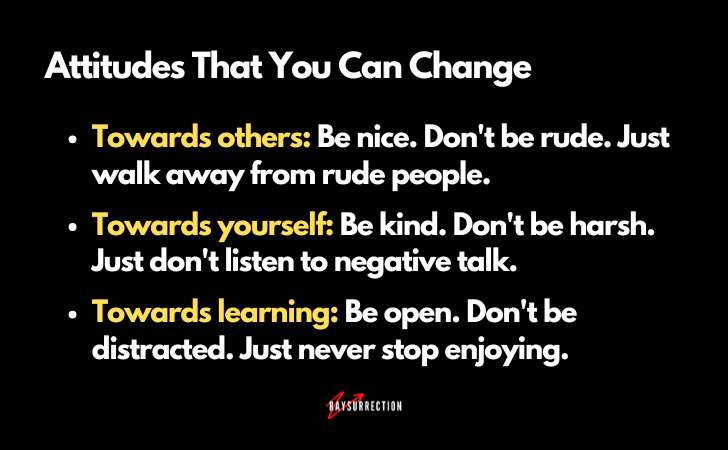
Attitudes That You Can Change
Towards others: Be nice. Don't be rude. Just walk away from rude people.
Towards yourself: Be kind. Don't be harsh. Just don't listen to negative talk.
Towards learning: Be open. Don't be distracted. Just never stop enjoying.

Our outlook can shape the way we deal with people, view ourselves, and approach learning. While some attitudes come naturally, others may require a shift to bring about better results.
Changing perspectives isn't always easy, but the rewards are undeniable. Below, we'll explore specific attitudes you can adjust in three areas of life with some bold and even quirky ideas.
1. Towards Others: A New Way to Interact
The way you treat others sets the tone for many interactions, yet shifting your perspective here can transform difficult situations into manageable ones. How you respond to rudeness, kindness, or indifference shapes not only relationships but also your peace of mind.
- Consider rude behavior as a reflection of the other person’s struggles. If someone is unkind, remind yourself that their actions often stem from their own issues. By imagining them wearing oversized clown shoes, you might find it easier to take their words less seriously.
- Turn irritation into an opportunity to learn. If someone annoys you, ask yourself, "What motivates them to act this way?" Viewing their behavior as a puzzle to solve can turn frustration into curiosity.
- Transform compliments into an entertaining challenge. Make it a point to offer unusual and specific praises, such as, "You’ve mastered the art of tying shoelaces!" These quirky acknowledgments can surprise people in a positive way.
- Exit negative interactions with theatrical flair. If a conversation takes a nasty turn, leave calmly but dramatically, like pretending to adjust an invisible royal cape. This approach can defuse tension without escalating conflict.
What kind of interactions frustrate you most? If you approached these situations differently, would you feel calmer or more empowered? Reflecting on these possibilities might shift how you handle challenging relationships.
2. Towards Yourself: Taming the Inner Critic
How you speak to yourself shapes your confidence and daily experience. Adjusting self-directed attitudes isn’t about perfection—it’s about making deliberate, playful changes.
- Respond to self-criticism with exaggerated compliments. When you think, "I’m terrible at this," counter it by saying, "I’m a misunderstood genius in the making!" By flipping negativity into humor, you can lighten your mood.
- Frame your mistakes as amusing trivia. If you mess up, imagine it as part of your personal trivia collection. For example, turning "I spilled coffee on my shirt" into "I’m an avant-garde fashion designer!" can make mistakes feel less serious.
- Speak to yourself as you would a close friend. Imagine a younger version of yourself and offer kind, encouraging words. Saying, "You’re learning; let’s try again," can replace self-blame with a constructive mindset.
- Embrace your quirks by treating life like a sitcom. If you trip on the sidewalk, imagine it’s part of a comedic storyline. Laughing at your clumsy moments can make them feel lighter and less frustrating.
What does your inner voice sound like when things go wrong? If you chose to respond with humor or kindness, would it change your confidence or outlook? Experimenting with these shifts might lead to surprising results.
3. Towards Learning: Staying Curious
Adjusting your attitude toward learning doesn’t require formal education. It’s about finding new ways to enjoy the process of discovery and staying interested in the world around you.
- Use distractions as rewards instead of obstacles. If staying focused feels hard, make deals with yourself. For instance, after reading five pages of a book, watch a short video or snack on your favorite treat.
- Treat every topic like a mystery to solve. Instead of approaching subjects as tasks, ask yourself, "Who benefits from this knowledge, and why?" Making learning feel like uncovering secrets can add intrigue.
- Invent strange uses for dull facts. If you’re studying something tedious, imagine applying it in unusual ways. For example, learning about cloud types could inspire a fictional story about sky pirates.
- Start by exploring the weirdest or most surprising detail. Begin with an odd fact or unique perspective about the topic. For instance, in history, dive into bizarre events before tackling broader themes.
Which subjects or topics feel like a chore to you? If you approached them with creativity or humor, could they become more appealing? Testing this method might reveal new ways to enjoy learning.
You can start changing your attitude today - choose playful shifts and bold strategies, and you;ll be able to reshape how you view others, yourself, and learning.
Small, deliberate adjustments paired with creativity can refresh perspectives and bring unexpected rewards. Imagine the possibilities of transforming even the most frustrating moments into opportunities for growth and enjoyment.
